


I remember in my first impressions of the country being rather surprised that things don't look much different here than in many parts of the U.S. Most houses are made of wood, apartment blocks still follow modernism, a large percentage of people drive (compared to the rest of Europe) because the towns and cities are relatively low density and subject to sprawl (where geography allows). The culture can seem peculiarly shy, or keeping to small circles of friends but having lived in New York the anonymity does not seem so new (when do city dwellers ever meet their neighbors anyways?).
Despite many apparent similarities, there are, of course, differences - even when masked in subtleties. These differences become all the more important entering the second year in this country - as I attempt to insert myself into the legal system here obstacles continue to appear reminding me that I am not from here and that I do not always have the most clear or complete understanding of my surroundings that I was used to in the U.S. - from social situations that are at the easy end to adjust to, to navigating the infrastructure I interact with every day to various degrees of success.
A very humbling experience yesterday brought this to light when, despite 13 years of holding a driver's license in the U.S., I managed to fail the practical driving exam in Norway. Ironically, or perhaps appropriately, the major fault in the exam was a matter I find to be a shining example of the very subtle differences between the countries. In Norway, a driver does not stop at an intersection - rather they slow down and apply a 'right hand rule' for determining the right of way. Having been explained this rule, and thinking I had understood it I realized to be a very different from practicing it. I find it simple enough to watch to your right as you drive and allow people to go in front of you, but when I approach and intersection it is too bred into me to stop and wait for the traffic to clear before continuing. Maybe it can be the fault of having been a New Yorker (or Bostonian for that matter), or maybe it's simply coming from the U.S. Directly or indirectly, we are taught not to trust other drivers and we operate in a system with limits to prevent interaction when possible. I certainly don't have the experience to judge if one of these is somehow better than the other, but I find it to be potentially an interesting commentary on the link between very basic infrastructure (form and rules) and culture.
Image found in Norwegian traffic discussion thread:
http://www.diskusjon.no/index.php?showtopic=641518
Zurich Area:


Trondheim Area:


Trying something a little different here, comments welcome - am keeping my eyes open for an outlet where I might be able to publish this/later work..
It has been a few weeks now since I moved here - to Oslo, to Tøyen. At the grocery store (the larger option in the neighborhood boasting lower prices) the woman in line in front of me wears a burqa. It is a common sight here and I am getting used to it, but I cannot help myself from wondering about her. Where is she from, how long has she been in Norway, does she speak the language, what will she be making for dinner? The differences between us seem accentuated by this one, highly symbolic piece of clothing. We leave the store with our bags and walk in the same direction for a bit, until she turns down a street consistently peppered with various others donning hijab and headscarves. I continue to my own rented apartment.
At my front door, I greet my neighbor on his way out but still in his business-casual dress from the workday. Our building is an old one - solid, possessing character. The apartments inside have been recently renovated to achieve a clean and modern look - energy saving appliances and all. When I take out the trash in the evenings, I must unlock a massive gate leading to the courtyard - a modestly sized space with potted plants and views to greener neighboring lawns. A small table and some potted plants render asphalt plot as cozy. From this space I have coffee and waffles and watch more neighbors come and go. I cannot but acknowledge that we are all the same - young professionals seeking reasonable rent and comfortable rooms. There are no burqas or bright headscarves in my building.
I remember back to the realtor's showing of my apartment. We had arrived a little late and there was a room full of visitors who were just leaving. My boyfriend was the only native Norwegian entering a room that well displayed the diversity that the city of Oslo hosts. Tøyen after all, is known for being multicultural - and for having cheap rent compared to similarly central neighborhoods. The well dressed realtor did little to hide his eagerness to speak to us, and it was shortly after the door closed on the last other visitor that we were informally offered the apartment. This approach was not overly surprising - we had sensed similar interest at previous showings and had already turned down one apartment despite the tight market. It seemed to follow as we are a clean, polite young couple with good educations, a steady income, and the added benefit of northern European genes.
A week after accepting the apartment we read in the local newspaper that young adults from minority backgrounds and students are having excessive difficulties in the rental market. I think back to our visits to other apartments and realize that our demographic is the competition in this market. Not yet established enough to buy, still saving and unwilling to spend too much on rent thereby drawn into neighborhoods characterized by increasing disparity and change. I think again of the woman in the burqa and my architect's mind is drawn to the long block of lesser kept modernist housing where she turned. Those blocks have few balconies and no coutyards - that era of Oslo housing in these parts focused on function - quantity over quality. I do not know how big or light her apartment is, or when it was last renovated. It is certain that, unlike the pattern of residents found in my building, those of neighboring buildings are not all the same. Only a few blocks separate us, we are one community yet we share little beyond the sidewalks and buried infrastructure.
Going back to the gate on my building's courtyard, I wonder why it is locked. Why are other members of the community invited to share 'our' communal space? I walk down local streets where the only trees and greenery to be glimpsed is tucked behind other buildings, locked within large gates, buried in courtyards. While I appreciate that my back window has a view of some trees, I fear that it is unfair to the rest of the community. Some others have no yards by their homes; others have more beautiful ones than mine. I pay more and more attention to the individual people in my community and I wonder just how different are our parallel and adjacent lives.
Mostly, I am quiet in public though I make a point of smiling to the people I pass on my street. At our subway stop, diverse visitors and tourists often ask me for directions - I respond to them as best I can. In stores, I greet shopkeepers and rehearse well practiced phrases hoping not to be caught off-guard with questions outside of the routine. Even though I too, am shut out of the locked courtyards in the district of Gamle Oslo, I feel somehow integrated into this disconnected community. By all outside appearances having fair skin and blue eyes I am typically mistaken for Norwegian, but - as is revealed by the color of my passport and my difficulty pronouncing ø, æ, and å's in conversation - in actuality, I am just another immigrant here.
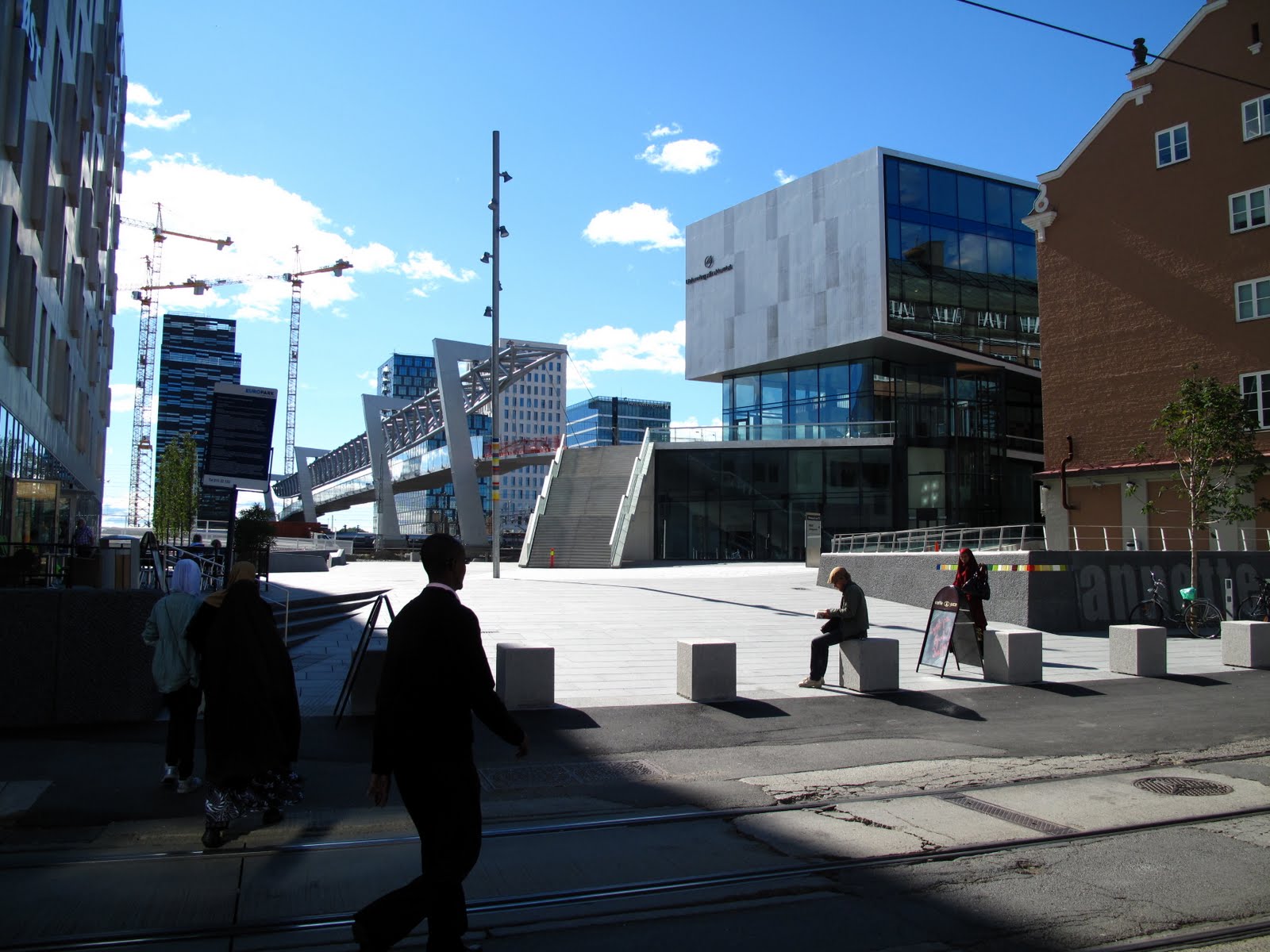
The forefront of sustainable development? Or, just a shiny new front along the water for the city of Oslo.. A couple shots of the ongoing construction towards a new city area - somewhere on the other side of the railroad tracks building after building is being built on what is likely newly filled land from the fjord-front.


I read a blog a few weeks ago wherein the author held a firm stance that it is impossible to go 'off the grid' in this day and age (http://www.infrastructurist.com/2010/07/29/is-it-possible-to-go-truly-off-the-grid-a-guest-post/). It was a good reminder of everything 'the grid' encompasses, and the fact that whether we realize it or not, we are all connected. There are services we share as a society - whether you are living 'remotely' in the countryside off a long driveway or in a dense city where you see your neighbors every day. What strikes me as interesting is that with all we share, why is it so difficult for western society to identify with the concept of communal resources. Is it because our electric wires and sewer systems are buried underground, or is it simply that the road has been there so long we forget that it belongs to all of us?
Now that I am returning to city life I will continue to ponder this and wonder how it is that we designers might be able to exploit the communal-ity of infrastructure and help residents understand the connections that make their (local) world work. And further, to help us remember that the most important systems we need to deliver the resources we live from are not only the man-made technological ones, but also those natural ones which we so often take for granted.

