Tuesday, June 29, 2010

Taming Wilderness

Over an hours drive from the nearest city, about 5 kilometers on a windy uphill path from the highway and across a couple rivers in Nordland lie a series of farms which were established in the 1830s. Making the hike up from the E6, on what is now a series of decently marked paths in part of Friluftsliv (or outdoor, literally 'free air <=leisure> life') tourism, makes one wonder how and why these farms were ever founded and maintained up until the 1970s. 


(Bredek farm is top, center in the distance)

The answer turned out to be fairly simple - at the time, the farmland in the valley served by roads was running short, so farmers were forced upland and into remote areas to establish fields and grazing pastures. Along with this, I can only imagine, came a heavily work-ridden life removed from society around. The alternative option or next step in this migration turned out to be the expensive and arduous move to America where accessible, flat land was still plentiful. 

Above is one of the first fields found on approach to Bredek. The stone wall is as old as the cultivation - having been built from the rock found when clearing the land. The full farm follows, with much of the older equipment still intact - from wooden sickles to steel wood stoves which must have been hauled to the site. The farm's environment and site is exquisite in nature with the views to the mountains, shelter from strong winds, natural water sources and constant reassuring sounds of a nearby waterfall and the woods full of birds and wildlife. 


Two-thirds of the way back, spotting the highway and railroad infrastructure below, the remoteness really sank in.

The concept of living off the land, and the very real proof that this earth does not hold the capacity for everyone to do just that today. The need for cities and densities becomes clear, but how do we reconcile this with man's desire for space and yearning for natural surroundings. My very presence in this place seems to bring the story full circle without quite answering any of the questions. Settlers moved from Europe to the New World for land and opportunities, built cities far removed from farming sensibilities and nature, and bred a generation of assorted urbanites - some of whom, like myself, now seek a break from the stifling city life to better reflect on its problems only to find that perhaps we simply end up back where we started.

Friday, June 25, 2010

Wilderness

A trip and several hiking tours up north have had me thinking a lot about wilderness - those natural areas still untouched by man, and how such a landscape transforms slowly over time once we drag our infrastructural entourage through an area. It seems fairly evident how humans change nature when we tread over it, but I also wonder how it changes us. I find more and more of my observances here in Norway certainly reflect some societal practices that have been created and or adapted over time as an effect of the local natural world. My next few posts will delve into this theme of man vs. nature (or is it man in nature, or nature around man, or just nature alone?).

One of the introductions that many foreigners get to Norwegian culture is a saying: "There is no such thing as bad weather, just bad clothing." While one might laugh it away the first couple times they hear it touted, there is definitely something to it. I'm not sure that I've been anywhere else in the world where a cold, rainy day would be so quickly deemed appropriate for a long hike, yet here I find myself again and again encouraged to layer up and head outside despite (or perhaps in spite of) the weather.

All fashion morals aside, last week I donned a full (borrowed) rain outfit for a leisurely stroll in some hills around the Rana and Saltfjellet areas. While the look isn't one I would have tried out in New York, here it works - in the least saving one from cooping themselves up inside for weeks in the name of bad weather.


Hiking comfortably in the rain also makes it possible to experience some ecologies that go unseen on dryer days.


Giant ant mound


Snail


rainbow

Thursday, May 20, 2010

Where is the sustainable ghetto?

A chain of thoughts has been developing in my mind, so thought I'd share them here before polishing them up into some cleaner form. I began research and note-taking for a term paper in which I wanted to dispel the values of territorialism in urban ecological planning, as applies to New York and how working locally might not always be the best solution. My mind keeps returning to the fact that community participation can only work within an educated and informed community.

Beyond this barrier is the concept of resources - resource sharing, distribution, pooling, management. Herein, I find territorialism's weakness - by limiting a resource base, inequalities and disparities between neighboring communities are inherently made more obvious. Territorialism might be nice for communities trying to preserve tradition, but it can not work to bring disparate communities together.

My thoughts keep returning to Long Island City and the transformations I saw underway there. There is such a huge difference between the rent/apartment prices in the new buildings popping up along the river and the rest of (/former residential) LIC, breeding new demographic shifts. Over the two years I lived there, I saw the two small commercial areas becoming more and more distinct from each other - and holding very specific segments of the small area. The new towers claim 'sustainability' while bringing luxury to (part of) the area, creating new social boundaries. The rent of the new buildings has to be inflated to balance the greater initial investments by 'green market' seeking developers. Incoming residents of these towers do not join those living in their shadows shopping at the budget C-Town grocery, even though the 4 or 6 block walk is convenient.

Many people overlook or seem to forget it, but sustainability has a social component, a component of equity which seems to fight with economics. It's great if the costly solar panels on a new building contribute to its electricity usage, but what about the neighbors - the existing communities - who might be forced to move and dissipate in order to continue to afford their meager existence living on the grid?

Saturday, April 17, 2010

Subtle Sustainability

Sometimes I am afraid that I have become too comfortable in Norwegian, as I begin to realize all that I have been taking for granted which is going on around me. For instance, I have realized there are a whole host of sustainable (and sometimes not completely sustainable but interesting) implementations and infrastructure here which I use on a daily basis, but have yet to share with many potentially interested parties back home. The more I have thought about it recently, the more bits come to mind, so I thought I'd share a bit of a list of sustainability related 'facts' I have come across in the past 8 or so months here.

*Disclaimer - many of these simply were derived from casual conversation and I have not done all the background research, so the range of specific accuracy may vary here.

One big one, which I was reminded of by a news article referring to Denmark - but Trondheim burns its trash for electricity and heat. The District Heating System is pretty interesting and quite large - covering (at minimum) the heat of all municipal buildings in the city. This is greatly minimizing the ventilation requirements of included buildings. Many buildings I've encountered (including my student apartment building) operate via passive/natural ventilation.

Some side notes with this... By trash, I mean 'avfall', or items not recycled in paper/plastic/glass/metal. I have further heard that all packaging plastic allowed in Norway is required to be of a certain compound which can be burned without releasing toxins into the air.

Also, building demolition and construction waste is highly regulated in Norway - 60% of materials removed from buildings are required to be reused or diverted from landfill, and localities commonly have centers for building material reuse/resale. These centers often employ people for sorting and cleaning materials on an hourly basis, creating laborious, but paying jobs for those with drug addictions and other problems hindering regular work.

Norway produces more electricity through hydropower than they use on an yearly basis. While commendable, there is a small catch to this.. Through the summers, a great surplus of energy is produced and exported through Northern Europe, but hydropower cannot be produced in the winter months, when rivers have frozen over. It is also during the winter that Norway consumes the most electricity for heating - this is purchased back from, sometimes unclean, sources in continental Europe. I have heard that in the 1980s or early 1990s, an ad campaign ran on the national television station actually encouraging Norwegians to use more electricity, because it is clean. The other concerning downside to this is that many appliances here, heaters and stoves in particular, run off of electricity, which is less than efficient.

To be fair, the (very progressive) building code in Norway is forcing incredible amounts of insulation and high R-values, and has planned for zero-emission buildings level requirements for the near future.

I am sure there is plenty more which will come to mind to be shared later.. But today, in the shadow of clouds of volcanic ash, one must recognize the shear power of nature - with or without humans and their destructive habits. I'm finding the flight groundings a bit refreshing in an ironic way.. The last time this Icelandic volcano erupted in the 1800s, it kept going for a full year - I cannot personally remember the last time in my life I went an entire year without taking a fuel guzzling flight, just imagine the environmental implications of grounding entire countries for any period of time.

Monday, April 12, 2010

The Snow Melts, the Ground Thaws

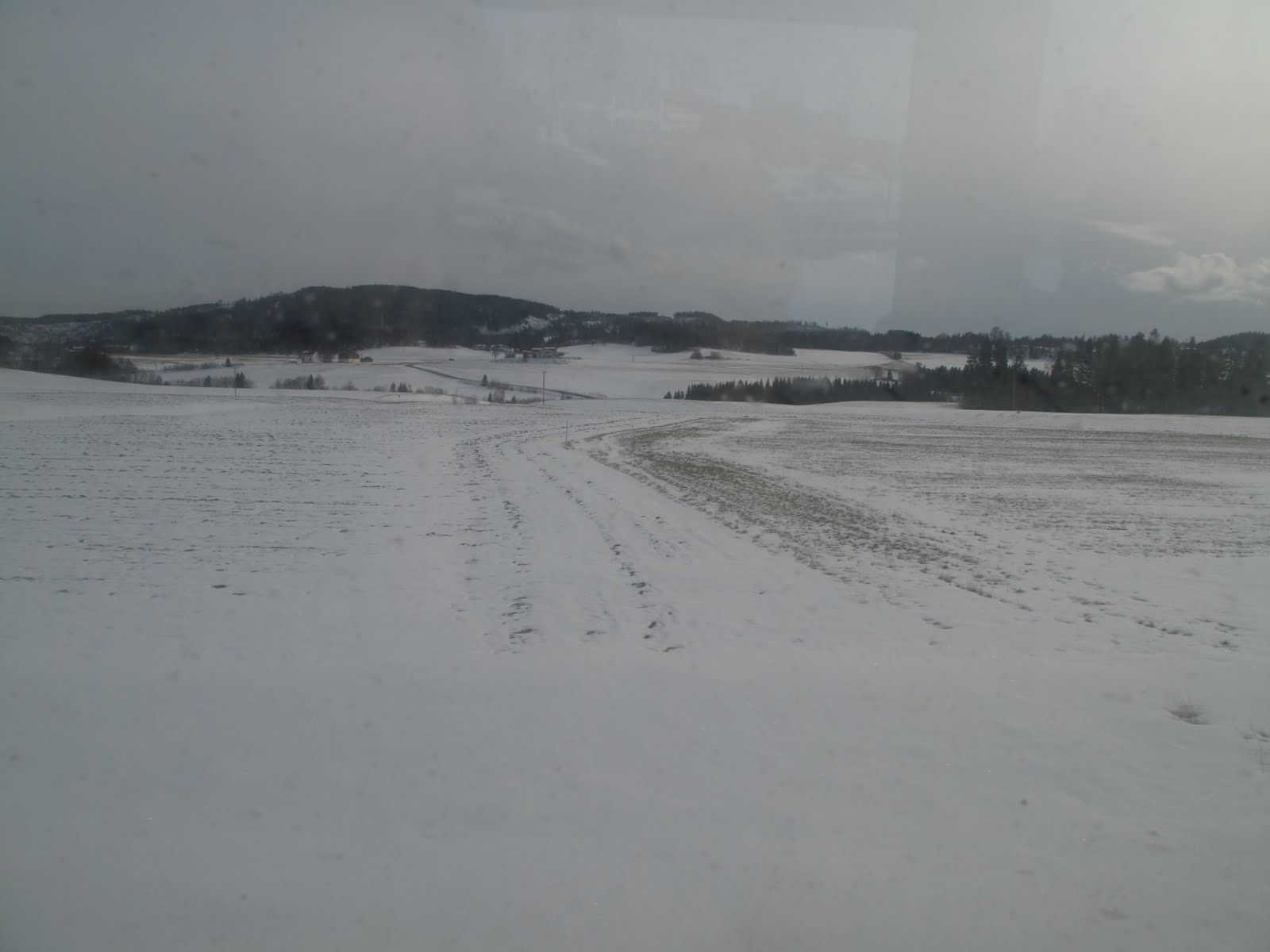
Last Fall's farmer's furrows froze. The spring snow's gradual melting again reveals the geometry of cultivated landscape over central Norway. With the reappearance of field demarcations, the land returns to its seasonal status as a venue for privatized production.


Wednesday, April 7, 2010

An Awareness of the Environment

Last week, I took the opportunity to join a family on a very Norwegian Easter holiday up north near where the arctic circle passes through the country. We skied and picnicked through remoteness, often with very little sign of fellow skiers or concept of land ownership and boundaries. It was the most true experience I have found of Allemannsretten, and leads me to a better understanding of the relationship between Norwegian culture and the environment.


The Scandinavian Easter is about the sun. It is an important holiday period marking the end of winter darkness and celebrating longer days. And the days are noticeably longer - where I was, around 66 degrees latitude, a slight glow from the sun still remained over the nearby mountain ridges at 9:00pm. What is more, the Easter week is one of the first times when one can feel full radiation from the sun, after many months of only seeing glimpses of it from shallow angles.

My hosts from Rana introduced me to many Easter traditions, and thinking back, it is impressing how many of them are related to the sun and environment in general. Skiing is a major activity, as even so far north, they are approaching the last month of skiing. Beyond recreation, skiing becomes a form of transportation in and of itself, allowing people to reach places beyond car and utility access - pristine nature. It is also the best weather for outdoor activity, as the temperatures creep above freezing, and the sunlight makes spending hours outside very pleasant, even without multiple layers of clothing.

Sunbathing and outdoor picnicking is probably a close second to skiing over Easter. Families ski for hours and then search out perfect spots in the wintry landscape. The goal is to find a large rock or mound that can shelter any wind, then make camp on the sunny face - taking advantage of the natural heat. When at a lack for an ideal spot, it is not uncommon for Norwegians to dig their own. Carrying a shovel (and often a compass) on any trip - the ability to dig a few feet into a snow bank and create a leeward, sun facing bench comes naturally to those making ski tours. Any chance to be outdoors was seized and celebrated.


I was greatly impressed to be able to comfortably spend so much time outdoors in such a climate.

Monday, February 15, 2010

Copper Trees

Providing a bit of green in a park that is covered by snow perhaps 5 months out of the year, Vigeland cast his trees in copper for the Frogner Park in Oslo.