Wednesday, September 16, 2009

Kathmandu Intro

Finally finding a comfortable internet connection, I have a bit of backlog to post. Will reorganize from this point forward though.

Day 1 – Friday, 11 September

Arrival to airport after 26 hours of flights and layovers – that in Delhi being the worst. There were leaks coming through acoustic ceiling tiles, soggy tiles falling in the corridor, bamboo planters that seemed to be for decoration placed strategically midhallway under the largest of the leaks to mitigate. Guards (Military? Airport security?) were walking around with exposed handguns and militaristic uniforms. We waited in one glassed in room for 4 hours to receive boarding passes, crossing our fingers that the airline (which had been on strike the day before) would take care of transferring our luggage as none of the 13 of us students and professor had an entry visa to the country of India.

All went well in the end, the hotel hired taxi from the Kathmandu airport provided quite the welcoming experience. Our luggage was strapped to the roof of an SUV. They drive on the left side of the street here and traffic rules are lax at best – largest vehicle governs all. The smell of dust and diesel stung my throat and nose through the ride. In the street (as there is no street sidewalk definition), I saw children sorting trash, old men cooking over open fires, mangy dogs nursing pups, the thinnest cows in my life, some goats loosely corralled and free monkeys. Many buildings appeared vacant or under construction at first glance, but then you can make out a family’s laundry hanging on a line in the top floor, clearly only accessible by a stairway that one would think should be closed (with a railing at least?) but the walls have either not been built or have fallen down at some point. The recurring thought in my head during this ride was “this is real, I have seen this in photographs, but this isn’t a photograph, this isn’t a documentary, this is real and I am here.”

Three days in, I have become accustomed to the shock factor, but still sometimes I find myself shocked at what I am seeing and mentally recording. This place is overwhelming yet wonderful – filthy yet beautiful, loud but personal, and completely foreign but more real to life than any I have experienced.


Tuesday, September 8, 2009

To Kathmandu


After a whirlwind couple of days of last minute vaccinations, laundry, packing and the beginning of goodbyes with my new friends in Norway - it is finally sinking in that I am really going to Nepal. My flight(s to be precise - the 4 leg flight-plan is roughly mapped above: Trondheim, Oslo, Munich, Delhi, Kathmandu) leaves on Thursday, and while there is plenty left to do I thought it a good time to give a little bit of an overview prior to being tossed into the life scale reality of Kathmandu.


The country of Nepal is about 4,000 miles away from my current home in Norway - just slightly greater than the distance from New York to Norway which I have already traversed. The country is nestled between India and China (Tibet actually), just at the base of and including much of the Himalayan Mountains. Interestingly, the time zones add just another 3 hours and 45 minutes to the time difference.

I will be staying in the capital - Kathmandu. A small but dense city, holding over 1 million people in an area of about 20 square miles according to Wikipedia (by comparison, New York holds over 8 million people in about 470 square miles which is about 1 in 58).

There have been a lot of questions about what my expectations are for Kathmandu and what I will be doing there. I don't have many answers - my personal intent is to remain as open as possible and involve myself primarily with taking everything in. My only expectation is that I will realize and embrace this as a very new experience and way of life for the next two months. My course program will guide the field work, so hopefully we will be able to gain some perspective on the urban problems in Kathmandu and manage to initiate something in the way of promoting communities to find means towards positive change.

On a lighter note, I'll share a bit of the pertinent advice I've received from my professor and local Nepalese students which I have been repeating as a small mantra in my head..

1- Don't pack too much, you'll "be heavier" coming back.
2- Don't drink the water.
3- Don't get knocked down a mountain by a donkey.

I'll do my best to keep aware of these three items, and will be blogging whenever free time, internet access, and electricity supply allows.

Also, my class will be contributing to a blog so feel free to keep an eye out for postings here as well: http://uep2009-kathmandu.blogspot.com/

Tuesday, September 1, 2009

Oslo is Contained

As brief as my visit first visit there, my first impression of Oslo is that it is a city contained. A fellow Fulbrighter is studying the preservation of open space particularly in the Oslo area, so I look forward to both more information and additional visits to the city later in the year.


The 27 minute Airtog express train carries passengers from the airport terminal to the center of Oslo. Perhaps 1/4 of the ride is a tunnel, but the majority of the rest looks something like this..

Re-approaching Trondheim

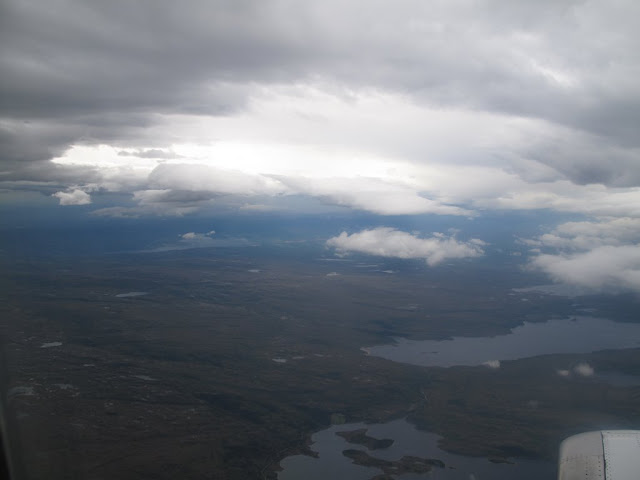
In the official countdown before I leave Norway for Nepal, I've had the opportunity in the past two days to document another perspective on the country, and the Trondheim area in particular. In a whirlwind two day trip for the Fulbright Orientation in Oslo, clear skies allowed me some aerial shots to hopefully better provide the bigger picture here. This country is beautiful - the topography is awesome in the most natural and surreal senses, and the sky and its many changes amaze me on a daily basis.


Sunday, August 23, 2009

Benches and Desire Paths


As promised, some visual documentation attempting to demonstrate open land rights in Trondheim.


And finally, a view from one of these benches.


Friday, August 21, 2009

Land Rights

The past few weeks in Norway, I've been continually aware of the lack of 'boundaries' in the Trondheim landscape. Street becomes sidewalk becomes drainage swale becomes a yard or a field of a farm. Sometimes the 'road' is no more than a gravel driveway or wide dirt path commonly used publicly by bikers and pedestrians alike - though you may be walking through a residential community, there is no concept of 'insiders' on these streets. Sure, some houses enclose their yards in hedges, but for the most part a neighbor could pass into the adjacent property lot with no clear marker and a pedestrian on the street could easily use what in the US would be perceived as a person's yard as a shortcut.

I had chalked most of this up to the small scale of Trondheim paired with low crime rates and a generally casual attitude of Norwegians, but the unclear separation of public and private outdoor space kept appearing. Along intersections and on random roadside (or pathside) hills I keep finding benches. They are placed so casually that anyone may stumble upon them to sit and ponder the landscape (the topography here ensures that there is always a view), but they are not consistent enough to be part of a public citywide 'parks' space.

I'll have to come back to this with some photographs another day, but a couple of lectures from classes this week have begun to shed some light on the phenomena I've been noticing. In Norway (and much of Scandinavia), there is a national law known as 'Allemannsretten' or 'every man's right'. It can also be called the Open Air Act or Freedom to Roam. In short, it allows every person of the general public equal rights to access most land - publicly or privately owned. Many travellers know of this because it's common knowledge that one can camp freely through most of Scandinavia, but I am still learning the details and extent of this law. http://en.wikipedia.org/wiki/Freedom_to_roam

Comparing Allemannsretten with what I have heard of land tenure battles in East Africa, or even with the traditional American fenced-in yard (or gated community!) that I know too well, I am becoming very intrigued as to the societal implications of this law (and practice). Remembering that my least favorite thing in Queens was the abundance of chain-link fence and property walls that serve little purpose than to receive graffiti, I imagine that a different frame of thought on land rights and ownership could seriously change an urban sidewalkscape for the better.

I am hoping to find yet another perspective on land rights when in Nepal in a few weeks. I hope to keep the line of thought in mind and see what parallels can be found between land ownership, societal norms/land use, and how the sense of citizen's responsibility to the land varies. At the moment I hypothesize that the concept of having rights and ownership to all the nation's land (shared with your compatriots) makes the society more personally responsible to the land and their environment. Perhaps knocking down a few fences could breed environmental stewardship.

For now, I'll go climb the unclaimed hill down the street to sit on its bench and read for a bit in the few hours of twilight left before the 11pm sunset.

Friday, August 14, 2009

Trondheim Flora


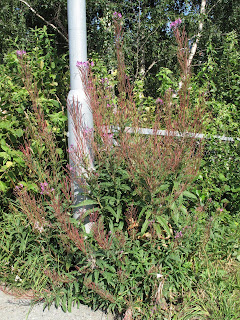
I need to get to a library and find some more information on the local plants, but the selection of roadside weeds has made quite the impression on me. Just thought I'd share some pictures here.