Saturday, November 21, 2009

Misguided Aid

I have been wanting to write about the actual field work my class did in Nepal, but it has taken a bit of time to get at least a small amount of distance and attempt to put it into perspective. My hope is that this will help me to be more fair to the entirety of the situation, but it is a difficult one regardless.

The full title of my course is "Urban Ecological Planning in Developing Countries - Transformation of Cities in an Eco-development Perspective". Students have entered into this program from many backgrounds and with many different assumptions about what Urban Ecological Planning actually entails. It quickly became clear to us that the Ecology here is not as driven by environment or nature as one might suppose, but rather thinking of systems of people. We began the course with lectures and discussions of the problems facing the urban poor and were given a set of readings about how planning and projects at the local level can serve as catalysts, helping communities to empower and strengthen themselves.

Before we left Norway, we learned that this year the course had 5000$ (US) from the Norwegian government to spend on implementing a project along with the typical research that the field work does. We discussed the pluses and minuses of this and all agreed not to let the money drive the research experience. Then we left for Nepal.

For two months there was a lot of talk about participatory methods and gaining input from the community. Our work seemed more directed at extracting information from the community in the form of household surveys - a practice that was difficult given the language barrier and seemed to my western self as intrusive. Nevertheless, we had survey information from 20 years ago for comparison and it did prove to give us a series of interesting information about our case community.

household survey process

Major issues unfolded in the case study, and each student (and each professor) took on one issue and did some research and produced a paper - something between a journalistic article and research paper. The issue topics included local governance, community organizations, water supply, solid waste removal, education, livelihoods, construction practices in an earthquake risk zone, open/communal space (-my issue which I will post more on later), women's roles, and social inclusion.

Working from these issues with specific focus driven by a couple community/teacher meetings the class derived a series of potential projects for the community of Sawal Bahal. To strengthen the roles and abilities of women in the community, the potential of starting a day-care center/work skill training program. To encourage social inclusion and make safer the play environment of the children, aiding the community in finding more formal owner/user-ship of some vacant land was discussed. To promote education and better the relationship between the community and the local school, a focus on improvements came up - ranging from bringing in different types of curriculum from environmental issues to music lessons to providing water to better the sanitation in the building. The students developed these potential projects and explored the obstacles in the way of each as time quickly ran out.

Up to this point, the program was research based, granted the research could have been better structured, but our tasks were reasonably product of our findings. This, however, is when the money came back into the picture. We found ourselves with one week remaining and $5,000 to spend in an economy where the national per capital income is little more 400$ a month. The question was asked if it is better to do something while we are there or leave without doing anything, and it is on this point I am still hung up.

The end product came from a panicked rush of activity and decisions that did not come from the careful participatory community work we had been doing, but out of convenience, showiness, and as seemed a final priority in the motivation, aid. The class (and our professor in particular) were incredibly fortunate for one very patient and capable Nepali student who took on the management and contact of the following projects which began in the final week of our time in Kathmandu.


First, it was decided that the school could be painted, and perhaps the local (actually defunct at the time) youth club would be willing to take on the labor in return for us supplying materials for both the paint job and some finalization of the construction of the club's meeting building. Next, at the push of a few adamant people, we were able to hire a plumber to examine and repair the water system of the school so that toilets could be flushed. The provision of water for this remains a bit tenuous since there is no municipal supply, but the school now has access to an existing storage tank, a new water pump, and some new faucets in each of the bathrooms. Finally, in a rush to obtain as many receipts as possible, the class was sent out to shop for books and toys to give to the school - the idea being that the children could use the toys and if a day care center was ever started then they too could use the toys. Upon receipt of the later, the headmistress of the school told us the problem for the youngest of kids is not that they need toys, but that they have no surface on which to play with such - the school's bare concrete floor and desks that were too large for kindergarteners were neither condusive to the young children nor to a future day care. After this comment, we used more of our fund to pay for some carpets and floor cushions to make a new setting for the little ones.

At the end of the day, these efforts were nice - even if hurried - gestures, but I cannot help feeling a great sense of disappointment at the incongruity between what we did and what we were supposed to be learning in this course. These projects maybe work to show immediate change, but it can be argued how meaningful or lasting any of these changes are. I am not sure that any of them could qualify for beginning a catalyst or helping the community to strengthen themselves. The major collaborative effort we attempted between the youth club and the school ended with the head of the community group starting the painting and then requesting that we hire laborers even though they had signed a contract that the club would do the work for the school.

How quickly after the work's beginning we left also makes me uneasy about what will be actually accomplished to working order. I do have to recognize that this community is and was fully capable before we came, and I completely trust that they (not us) know what is best for themselves. If/when they realize the entire school doesn't need to be painted, they would surely be clever enough to save or re-sell the materials and focus their efforts on better projects (they have already set up 3 different stations for water supply). After their collective decision to go after the vacant open space did not pan out to be legally feasible, the most active community group put a lock on the door to the lot (owned privately outside the community) and began a cleanup effort.

In Sawal Bahal, there do exist some major underlying issues concerning inequality, lack of education/literacy among adults in the community, and a range of attitudes for education of the children (never mind that few, if any, buildings in the area are built to legal limits or could withstand and earthquake). Our work was able to identify these problems, but it did not even attempt to alleviate them. Kathmandu, and even Sawal Bahal is crawling with international volunteers and organizations tripping over each other in the name of aid, but it's hard to see if positive change actually happens anywhere. I'm afraid that most of them, much as in our case, end the day with throwing a shiny new coat of paint on the walls but never addressing the cracks beneath.


leaving Sawal Bahal

Tuesday, November 17, 2009

Back to Frost


I fully intend to return to Kathmandu (in this blog at least) and tie up some loose ends, but for the moment I am very much back to Norway and early winter. After a few days here I have made a few observations regarding changes in the ground plane and in the sky above.

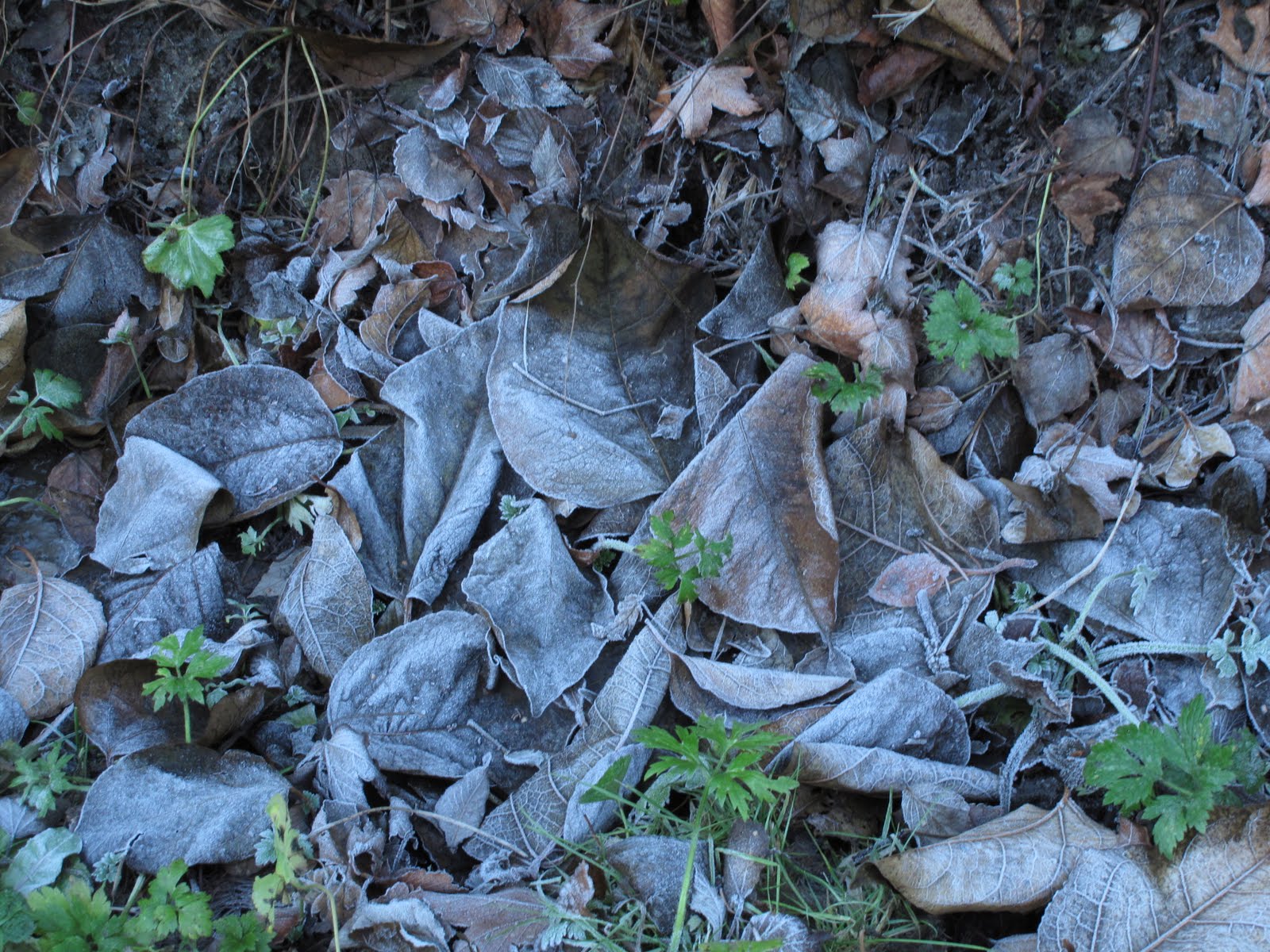
First, most of the earth is now frosty, maybe demonstrating the beginnings of a phenomenon of 'permafrost' which I can only begin to imagine. Growing up, I remember frost from winter mornings. I would wake up and wait for the school bus as the sun was just rising and all around, particularly in grassy areas, there laid a light dusting of slippery white that faded within the first hour of the sun being up. Here, I notice some differences - the frost stays, the sun does neither comes to shine on it nor has the power to melt it into dew with the passing of the day.


These photos were taken around 2pm, what should be near the warmest point of the day (and the air temperature is a bit above freezing). Please note that this is not snow - it hasn't snowed since I came back, and these frosty areas are in openings of forest that theoretically would see sunlight. Beyond grass fields, the frost also hits gravel roads and asphalt surfaces in a thick manner, appearing innocent enough but making walking paths extremely slick.


As for the sun and the sky, its habits this time of year here are quite peculiar. The first few days back in Trondheim I woke early and found myself waiting for the sun to come up the rest of the way to begin the day - only it didn't, and it doesn't. Rather than tracing a high arc through the sky, in winter at this latitude the sun actually makes a horizontal movement - appearing on the left of the sky around 7:30 in the morning and moving directly to the right through the course of the day, not to be seen again after 4:30. The result is a peculiar early morning feel through the entire day, but often an extremely beautiful indirect glow above the (ever present) clouds above.
11:30 am

4:30 pm


Friday, November 6, 2009

Multiple Identities

As the prospect of packing my belongings and leaving my two month home of Kathmandu approaches I am a little stuck on a concept brought up by last week’s conference on tradition and preservation in the Trans-Himalayan area. Many of the lecturers at this conference noted some fears of globalization and the way that contemporary life is forcing people to hold multiple identities – constantly pulled between the traditional and the modern. While I share neither a personal attachment to any “traditional” lifestyle nor the presented fears of loss of culture, I am lately very much aware the multiple identities which I hold.

Hidden back in my suitcase are several items which I have not looked at or thought about in the last 60 days – a down winter vest, some makeup, a student id from NTNU. There is a cell phone with a Norwegian phone number that I never managed to remember even though it belongs to me. Finally, there is a keychain holding the most solid and complicated key I’ve ever owned – one that ironically belongs to the most secure and safe place I have ever lived. The comparison of this key to my Norwegian small town student apartment to the flimsy piece of aluminum used for my hotel room is comical. These keys further remind me of sets I have held through other identities – especially those that used to be part of an internal “keys, wallet, phone” mantra that I would not leave my New York or Boston apartments without repeating in check. Such items become symbols of the habits which form our lives and how we identify with the world.

It is interesting to me the items one believes they cannot leave home without depending on a specific position in life/the globe, or to any one particular identity. I have not owned, or even used, a phone since September and I haven’t particularly missed it. In Norway I used my phone for social commitments and to check the time, in New York the phone was a storage device for any pertinent contact information – personal or business, and often held note reminders for those days when I would be without internet for several hours at a time. These objects and our relationships with them change with our circumstances and environment. In my case, “keys, wallet, phone” became “wallet” or “wallet, camera” by the time I got to Nepal, since life in a hotel allows the keys to be checked at the door. The breaks from some amount of materiality and the barriers to technology here have overall been refreshing. I am reminded of Thoreau writing in Walden how he feels bad to see the poor carrying all their belongings on their back, not because they are poor and have so little, but because they have to labor to carry so much which ties them down.

So here I have fallen into an identity between volunteer worker and transient long term tourist. My class has come here from diverse cultural backgrounds stretching from Norway and France to China and Japan, but in Nepal have become a fairly cohesive international societal unit. I will return to Norway with the full identity of a student, saying goodbye to some good friends and many familiar faces - realizing that some relationships will carry on in different capacities and others will disappear or change completely, along with the habits of the day to day. Being one to typically fight nostalgia and embrace change, I look forward to the new opportunities that later identities may afford me. For me, the possession of multiple identities is a key element, both in the personal development of the individual and in our collective ability to relate to each other, adapting into variously scaled and termed social groups. It may be that multiple identities is the clearest form of underlying social infrastructure in the global environment.

Thursday, October 29, 2009

Manual Labor and its Implications


One of the most obvious, and often most shocking differences that a Westerner can observe regularly in the developing world is the large scale reliance on manual human labor. Having lived in Kathmandu for nearly two months, I have mostly gotten used to seeing single men carrying refrigerators and other similarly sized/weighted loads down the street on their backs using a strap around the forehead while taxis and rickshaws carrying tourists weave between and around them. When the road outside of my hotel was repaved, there were no large machine vehicles in sight – rather a simple metal cart driven by a small tractor engine, holding a mound of pitch inched its way down the street while two men with shovels quickly scooped and smoothed the asphalt over the surface.

It strikes me again and again that the world is an unfair place. To various extents depending where you go and who you ask, it is clear that Nepal is still a caste based society - issues of discrimination between people based on profession (which is traditionally tied to the family name) still occur. I hear rumors that different low castes in Nepal have been recently acquiring more power and better, more stable working conditions since the Maoist movement has formally entered the politically arena here. From the sounds of it, the Deola sweepers are now finding opportunity in municipal janitorial positions which hold pension benefits and job stability, much to the chagrin of the farmers who are traditionally a much higher caste and find their livelihoods to be full of hard, thankless work by comparison. Traditionally, laborers and those who dealt with refuse/waste found themselves at the bottom of the caste system and labeled Untouchables – capable of contaminating the food/lives of the upper castes despite the necessary roles they filled in the context of up-keeping the city.

Perhaps inspired somewhat by the political environment here, I have began reading through a small survey of Marx and Marx-inspired revolutionary communist (and communist criticism) literature. One can quickly see the ways that the ideas/ideals can be romanticized and become popular in a context such as Nepal – where life is hard and poorly appreciated workers are plenty. The sickle and hammer symbol is by far the most popular form of graffiti to be found through the countryside.


Due to the topography of the country, many rural parts of Nepal (and 80% of the national population is rural) truly rely on human labor for their basic needs. I went on a 7 day trek in the Annapurna Sanctuary where Gurung villages largely support themselves by farming and trekking tourism. The tricky part to this is that when your village lies four (long) walking days and 3200 meters above the end of closest vehicular road few crops can be grown and all supplies from rice to cooking and heating fuel must be carried on the back of a porter.

The experience of this, and being here in general, has given me some serious questions about sustainability and social equality. On one hand, it can be argued that human labor is completely sustainable – we have no particulate pollutants in our emissions, we are theoretically a renewable resource, and the limitations of human strength perhaps help to deter over consumption. The counter to this would need to involve some digging through numbers concerning the amount of calories that a porter needs to consume to complete his work, and trace this back to the increased load on farmers to support such laborers (moreso if said laborers are not vegetarian).

Further, judging human labor as sustainable begs the question of what increased health problems and loads on medical facilities and insurance programs. While trekking, I was greatly concerned with the strong fumes coming from fuel tanks carried on the backs of porters while passing on the trail – not only are these men carrying heavy loads quickly on steep terrain, but they are also subjected to fairly toxic fumes for hours at a time. (Ironically, the fuel is necessary primarily because of strict limits against cutting and burning wood which have been imposed on the villages by the National Conservation Trust.) What social capital is lost in a village where most of the men spend their days (and many nights) away from their homes and families for work and then are presumably susceptible to disease and early death?

Many of these questions and problems extend into the developed world as well, but manifest themselves in different (often more clearly less sustainable) professions. Such risky professions are the epitome of social inequality. Unfortunately, I realize that even the ideals of Communism do not cure these problems. There can be plenty of discussion regarding workers’ rights and ‘equality’ between the proletariat and bourgeois, but how does one handle the fact that the world’s society has ‘developed’ in such a way that some citizens somewhere have to perform work which is inherently unsafe, unhealthy and thereby, unequal?

Monday, October 12, 2009

cross referencing

Just wanted to reference back to the sub-focus of my current coursework: http://uep2009-kathmandu.blogspot.com/2009/09/sawal-bahal-children-caste-open-space.html

We've become heavily involved with a small primary school in our study area, and simultaneously will work towards helping a strong community group secure some (currently) private open land to build a playground. I'll be posting more on this in time.

Also, an interesting read related to nature and society:

Circumstantial Gardening


Kathmandu is a city so strangled by development and pressures related to the values of land (which near doubles every 3 years) that natural green space seldom exists. The Nepali people, however are from a rich ecological state and it quickly becomes obvious that city dwellers go out of their way to create some semblances of the natural world. Plastic flowers adorn even the poorest lobby spaces and real plants can be found in more elaborate locales. The rest of the natural will of the populous is forced upwards – to the roofscapes of buildings. Nearly all roof terraces and balconies show small and large attempts at the urban provision of trees, shrubs and even lawns.

At times, the efforts seem to be striving towards overcompensation – to the point that the placement and containers for plant specimens can become haphazard and seemingly circumstantial. Bath tubs, oil drums and discarded containers of many materials become planters. The goal of achieving vegetation takes priority over the aesthetics of the means through which it is accomplished. Nevertheless, these informal, private green projects serve an important function – providing some of the only options for (near) peaceful retreat from the noise, traffic, and dust of the city below.