I've landed in Lapland of Northern Finland for a week workshop/think tank to consider the relationship between humans and nature. In the dialogues (between artists, scientists, and those of us who fall un-categorically between), we make the point of understanding humans as a part of nature - reversing "scientific" thought of removing oneself from the equation. Already on the first day, some interesting points have come up and I believe that I'm starting to reshape (or sharpen the focus of) my perspectives on sustainability.
One question from this morning was - since we humans are looking at nature and attempting to learn from what we deem as 'positive' or 'effective' qualities, do other objects in nature do this? Butterflies move their wings when hanging on trees to resemble leafs when predators are near without any cognitive ability to consciously know that their movement protects them. We had read some Darwin in the build up to the program, and we (as humans) tend to believe that plants and non-conscientious species adapt in reactive ways to somehow better themselves/the future of their species. An interesting note here is the habit of separating humans from the rest, but perhaps we too are simply reacting to our surroundings.
There has been a lot of talk about human impacts and how to mitigate the disturbances to ecosystems that we are causing - from lessening our consumption, to the potentials of creating new species to replace those that go extinct. There is a wide range of backgrounds and expertise at this workshop which bring a lot of new perspectives, reactions, and possibilities together (for better or worse). A point can be made in looking objectively at the human species on the planet that we are a biological case of overpopulation - a simple scientific thought with very complex ethical implications.
Fortunately so far, humans are not subscribing to the prescription of culling that we use when other species overpopulate an area and ruin resource bases or cause pollution (as you hear of for deer perhaps), but many are realizing that our impact must be lessened. Many people like to argue for or against sustainability as some kind of human duty to the planet, but I am realizing it can also be seen as a human duty to humans. Sustainability is a reaction the human species is developing to a threat - adaptations to species and to life habits are necessary if we are to continue to survive at current or projected population levels. Some questions remain in do we try to change ourselves, or do we try to change the world around us to accommodate us, or are both approaches necessary for the planet to support us?
I have noticed some seasonal effects to my blog writing - namely, that during the winter the weather and snow cover makes many observations difficult and that during the summer the weather and sunshine make sitting at a computer to write difficult. Keeping this in mind, I've spent a summer enjoying Oslo and taking photos, making mental notes of things to write about. Now that autumn has arrived in it's chilly gray splendor, I am finding some quality computer time to go back over those photos and thoughts.
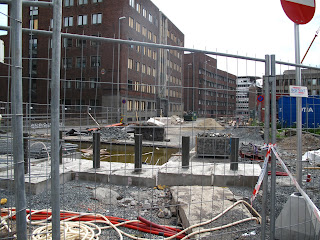
In general, it seems like urbanism is a new, but snowballing concept for Oslo. Norwegians are not accustomed to density, but the pressures are here and they're growing at a rapid pace. Globalization and rising populations are happening here as in any other world city, but there are some Oslo specific geographical aspects that currently prohibit sprawl. Oslo is located on a fjord and otherwise surrounded by an incredible >300 sq km cover of hilly forest. The forests are protected, and they are building into the water but for the most part, densification is the answer. It is interesting to watch the construction trends and see the car mentality of the last decades clashing with the progressive hopes for a sustainable city.
The future waterfront of Oslo with Bjørvika's center extension.
I am certain to come back with more detail on this topic later, but for now I offer two takes on pedestrianization.
Torggata - the almost pedestrian street.
Bar Code Area plaza and pedestrian bridge in background (urban design by MVRDV and others)
The pedestrian bridge, currently linking a gas station with a construction site over the train tracks, someday will connect the new "Opera Quarter" with whatever post-gentrification brings to (currently multicultural, working class) Grønland.
As often happens on a subtler scale, a few disconnected influences coincided over the past week which kicked off the thought process behind this blog entry.
First, I've been reading - in Norwegian - a book about the ongoing gentrification process in a section of my Oslo neighborhood which is becoming less and less known by the name 'Little Pakistan.' The book is called Tøyengata and written by a human geographer named Tone Huse who has conducted a research project somewhat similar to my thesis fieldwork, just five years or so prior. In the process of describing the neighborhood, Huse writes about the bias of both the passerby and of the researcher in a multicultural, largely Muslim neighborhood of a westernized city. To (somewhat poorly) translate and paraphrase, she writes that it is easy in this setting for one to allow themselves to be lead to misunderstandings, being blinded by the apparent foreignness of it all (the women in hijab, the asian pastry cafes, the exotic vegetable markets and the fabric shops).
"Miljoet er ikke ens egen. Og selv om en skulle være del av ett av Tøyengatas miljøer, er andre sider ved gata fremdeles ukjente." She writes that that environment is not one's own, and that even when you are a part of one of the street's communities, other side of the street remains unknown. Huse's words strike a resonance with me because I have been that passerby, that researcher, and I continue to be that resident misfit as I am now marking the end of my first year of living in Tøyen. Each day I leave my apartment and am confronted with cultures I know little about. Immigrant families in my neighborhood come from countries as far removed from Norway as Somalia, Iraq, Afghanistan and Pakistan. I feel like I learn a bit about these people each day, and each day I wonder more. We shop together in the markets and share public spaces and public amenities - in many cases we also share at least a second language knowledge (in my case) of Norwegian, but our lives rarely intersect.
In general, I greatly enjoy my neighborhood. In my personal, subtle ongoing cultural experiment of smiling to passersby on city streets, I quickly found that my smiles and nods are more often returned here than amongst higher native Norwegian populations nearby. Shopkeepers here strike up conversation and small communities develop around where people buy their vegetables. Despite these pleasantries, it is sometimes difficult to shake the perceptions of difference from all sides - boundaries do exist between groups of people here. There are stores and prayer rooms only frequented by the Somalian or the Pakistani populations, and there are local pubs only used by an older Norwegian crowd of regulars. These differences and boundaries can be frustrating to get past, but I find the interactions that happen in the spaces between to be of both great interest and of great potential as an urbanist and as a resident.
I think about these themes often, but they have seemed especially relevant in the aftermath of the 22 July attacks on Oslo and the heightened aftermath awareness of risks associated with prejudice. A Norwegian friend of mine shared a moving story on her blog about overhearing an account of Utøya from a surviver on a bus, with the poignant lesson of how we can never (and should never attempt to) know anything about a person at first sight, without hearing who they are, what they've been through, or what they aspire to.
These messages seem particularly important to me lately as well, while the political arena in the US reels. I'm afraid that sometimes it's all too easy for us as humans to forget humanity. Whether differences lie in opinions, ethnicities, social statuses or other realms, they are irrelevant at the end of the day. As humans, we are the same at the core and we hold the same basic needs and aspirations across our outward appearances and expressions. Political debates and pointing fingers against ideologies, immigration policies, or religious practices accomplish nothing towards what should be the greater goal of making society stronger and more sustainable.
I was contacted about my blog entry after the Oslo attacks via email by a film project called My Fellow American, which seeks to recognize the Muslim community in the United States as any other neighbors, any other group of citizens. To help them spread their message, I'm sharing their film at the bottom of this post. The point follows the the same in the US as in Oslo and Norway, as much as anywhere across the world. It seems to me that the understanding of our potential misunderstandings may be the key to cultural pluralism.
Film: My Fellow American - linked from youtube.com
Photo by Øyvind Tveter, found: http://cache.20minutes.fr/img/photos/20mn/2011-07/2011-07-22/article_oslo.jpg
Last Friday, when I first saw images published by Aftenposten such as the one above, one of my early thoughts after the horror passed was the irony of the bollards at this site. Having worked on various security landscape projects, I've held an amount of skepticism to the overwhelming number of bollards planted in the world, particularly in the past decade. Engineers tell us that these steel and metal forms can stop a vehicle carrying explosives in the event of a terror attack, keeping blasts from damaging the structural components of a building.
Seeing the aftermath of a car-borne blast outside the bollard zone here makes me question how much these stanchions actually help. While the building has not fallen down, it seems unlikely that it will be ever occupied in this form again. Further, rumors of possible structural instability have been circulated in the news, explaining added difficulty to the search and rescue process - so what actually have the bollards in all their perimeter multitude accomplished?
I ask this question more so now, after visiting the area surrounding the bombed site the other day. I took this photo of what seems to be new bollards going into place, effectively blocking the road to the targeted government building.
Perhaps these new bollards signal a new strategy in keeping vehicles off the route to important buildings and disallowing parking on such streets. In fact, in the aftermath of these attacks, a great many streets in Oslo have been closed to traffic while investigation, demolition, and reconstruction take place. It may now be a good time for the city to look at the benefits of pedestrian streets from a newly relevant angle and reconsider the auto-driven habits that clog city streets with parking.
Interestingly, in the new experience of the city, I find these blockages not to reinforce a landscape of terror and fear, as they well could. The barriers are lightweight and transparent, seeming (much like the law system in Norway) more suggestive rather than prohibitive or restrictive. Rather than people attempting to bypass these barriers, they have not only been respected as limits but have also been turned into memorials by the people. What could easily be an oppressive sign of fear another place, here has been transformed into a beautiful sign of grief and unity.
I've written a more personal note to this event in my second blog here, so I will keep this commentary short. However, from an urban perspective, experiencing this event has noted the transformation of a city in grief. These gates to the destroyed areas have becomes nodes in the city collecting people. Construction staging has created extra pedestrian streets and an open view feeling to the process of reconstruction. Destruction in some areas is being memorialized. Small statues, steps, and gates throughout the city bear flowers in mourning and remind passersby that we are all together in facing this tragedy.
Deconstructivism at its (natural) best. This landscape is around the mountain peak Melfjellet in Nordland - an iron rich area of sedimentary rock. As the pictures (from June) note, the area is under snow cover much of the year, with the main traffic artery left unplowed through winter, accessible by only skiers and snowmobilers. The summer thaw reveals forms that could easily inspire or compete with the last decades in architectural deconstruction formal thought.
Having moved to Norway nearly two years ago, I've been noticing subtle differences in the (physical, natural and planned) landscape - from topography to plant species. Now realizing the need for a more structured study of such phenomena (if I am to work in landscape architecture here), I will turn some of my blogging to this focus.
Starting with a reflection on some photos - unstructured observations over the past year in Oslo, which I will attempt here to structure into the following categories: what nature has planted in the forest and on the islands/coast surrounding the city, then what people shop atthe market and plant within the city.
For now, Nature - forest:
The forest plays a huge role in the lives and culture of Norwegians - even here in the city. Each weekend or evening day of good (and sometimes bad) weather, people flock by public transit and autos to the many entry points to the 300 (+) square kilometers of forest that surrounds the city (Oslomarka). In the winter, ski trails abound under conifers punctuated by busy "hytta" 's selling sausages, waffles and coffee. In the summer, more trails appear for hikers and mountain bikers, ponds thaw for swimming and fishing. Plants here are layered, from framing dramatic scenes over the fjord, then entering species-specific groves and finding a multitude of smaller flowering plants tucked into the brush surrounding paths and creeks.
The city forests are one locale in Norway where people greet strangers happily - society coming together to mutual enjoy and benefit from the health provided by nature. The proximity of this resource may be the most incredible aspect of Oslo - one can go from a hip downtown cafe (sipping 6$ coffee) to stumbling over moose droppings in about 20 to 30 minutes using the local subway or bus lines.
In the meantime I play to try keeping tabs on both the downtown flower market and the local botanical garden to see what's in bloom through the seasons. This will require a bit more discipline in scheduling on my part.
This year, when I set out to write a masters thesis on how city sustainability goals are breaking down at the local and neighborhood scales in Oslo it turned into 150 pages about values. What values we hold and why, which ones we share and what that can foster, and which we disagree with, halting communal goals.
The author asks (and in part answers) why are cities not investing more in emotional infrastructure. Understanding that things we love thrive because of the extra effort, can the same approach not be taken for cities? How can we as designers, planners, and everyday citizens encourage our neighbors to care about and personally invest in a place?