Thursday, May 20, 2010

Where is the sustainable ghetto?

A chain of thoughts has been developing in my mind, so thought I'd share them here before polishing them up into some cleaner form. I began research and note-taking for a term paper in which I wanted to dispel the values of territorialism in urban ecological planning, as applies to New York and how working locally might not always be the best solution. My mind keeps returning to the fact that community participation can only work within an educated and informed community.

Beyond this barrier is the concept of resources - resource sharing, distribution, pooling, management. Herein, I find territorialism's weakness - by limiting a resource base, inequalities and disparities between neighboring communities are inherently made more obvious. Territorialism might be nice for communities trying to preserve tradition, but it can not work to bring disparate communities together.

My thoughts keep returning to Long Island City and the transformations I saw underway there. There is such a huge difference between the rent/apartment prices in the new buildings popping up along the river and the rest of (/former residential) LIC, breeding new demographic shifts. Over the two years I lived there, I saw the two small commercial areas becoming more and more distinct from each other - and holding very specific segments of the small area. The new towers claim 'sustainability' while bringing luxury to (part of) the area, creating new social boundaries. The rent of the new buildings has to be inflated to balance the greater initial investments by 'green market' seeking developers. Incoming residents of these towers do not join those living in their shadows shopping at the budget C-Town grocery, even though the 4 or 6 block walk is convenient.

Many people overlook or seem to forget it, but sustainability has a social component, a component of equity which seems to fight with economics. It's great if the costly solar panels on a new building contribute to its electricity usage, but what about the neighbors - the existing communities - who might be forced to move and dissipate in order to continue to afford their meager existence living on the grid?

Saturday, April 17, 2010

Subtle Sustainability

Sometimes I am afraid that I have become too comfortable in Norwegian, as I begin to realize all that I have been taking for granted which is going on around me. For instance, I have realized there are a whole host of sustainable (and sometimes not completely sustainable but interesting) implementations and infrastructure here which I use on a daily basis, but have yet to share with many potentially interested parties back home. The more I have thought about it recently, the more bits come to mind, so I thought I'd share a bit of a list of sustainability related 'facts' I have come across in the past 8 or so months here.

*Disclaimer - many of these simply were derived from casual conversation and I have not done all the background research, so the range of specific accuracy may vary here.

One big one, which I was reminded of by a news article referring to Denmark - but Trondheim burns its trash for electricity and heat. The District Heating System is pretty interesting and quite large - covering (at minimum) the heat of all municipal buildings in the city. This is greatly minimizing the ventilation requirements of included buildings. Many buildings I've encountered (including my student apartment building) operate via passive/natural ventilation.

Some side notes with this... By trash, I mean 'avfall', or items not recycled in paper/plastic/glass/metal. I have further heard that all packaging plastic allowed in Norway is required to be of a certain compound which can be burned without releasing toxins into the air.

Also, building demolition and construction waste is highly regulated in Norway - 60% of materials removed from buildings are required to be reused or diverted from landfill, and localities commonly have centers for building material reuse/resale. These centers often employ people for sorting and cleaning materials on an hourly basis, creating laborious, but paying jobs for those with drug addictions and other problems hindering regular work.

Norway produces more electricity through hydropower than they use on an yearly basis. While commendable, there is a small catch to this.. Through the summers, a great surplus of energy is produced and exported through Northern Europe, but hydropower cannot be produced in the winter months, when rivers have frozen over. It is also during the winter that Norway consumes the most electricity for heating - this is purchased back from, sometimes unclean, sources in continental Europe. I have heard that in the 1980s or early 1990s, an ad campaign ran on the national television station actually encouraging Norwegians to use more electricity, because it is clean. The other concerning downside to this is that many appliances here, heaters and stoves in particular, run off of electricity, which is less than efficient.

To be fair, the (very progressive) building code in Norway is forcing incredible amounts of insulation and high R-values, and has planned for zero-emission buildings level requirements for the near future.

I am sure there is plenty more which will come to mind to be shared later.. But today, in the shadow of clouds of volcanic ash, one must recognize the shear power of nature - with or without humans and their destructive habits. I'm finding the flight groundings a bit refreshing in an ironic way.. The last time this Icelandic volcano erupted in the 1800s, it kept going for a full year - I cannot personally remember the last time in my life I went an entire year without taking a fuel guzzling flight, just imagine the environmental implications of grounding entire countries for any period of time.

Monday, April 12, 2010

The Snow Melts, the Ground Thaws

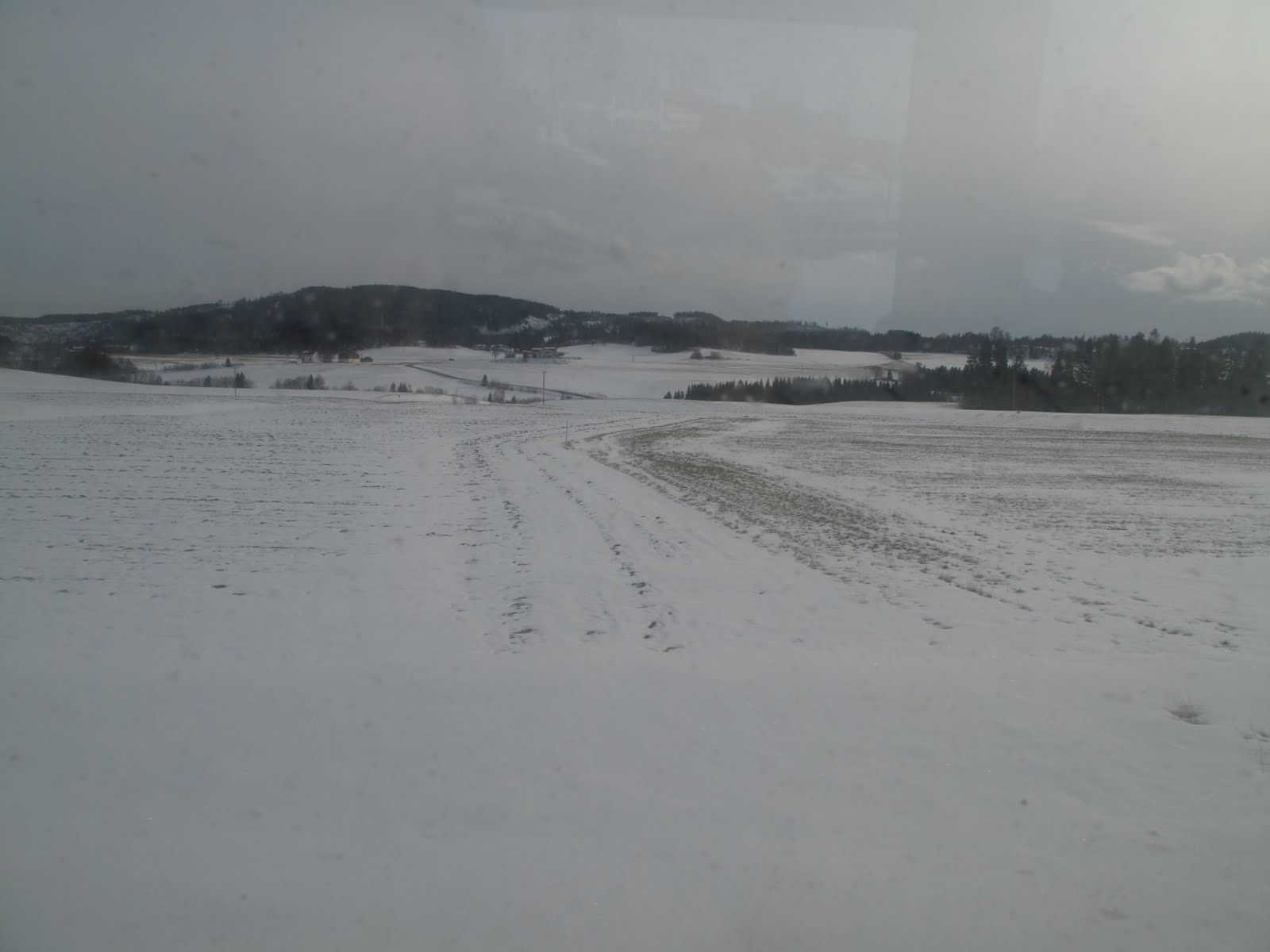
Last Fall's farmer's furrows froze. The spring snow's gradual melting again reveals the geometry of cultivated landscape over central Norway. With the reappearance of field demarcations, the land returns to its seasonal status as a venue for privatized production.


Wednesday, April 7, 2010

An Awareness of the Environment

Last week, I took the opportunity to join a family on a very Norwegian Easter holiday up north near where the arctic circle passes through the country. We skied and picnicked through remoteness, often with very little sign of fellow skiers or concept of land ownership and boundaries. It was the most true experience I have found of Allemannsretten, and leads me to a better understanding of the relationship between Norwegian culture and the environment.


The Scandinavian Easter is about the sun. It is an important holiday period marking the end of winter darkness and celebrating longer days. And the days are noticeably longer - where I was, around 66 degrees latitude, a slight glow from the sun still remained over the nearby mountain ridges at 9:00pm. What is more, the Easter week is one of the first times when one can feel full radiation from the sun, after many months of only seeing glimpses of it from shallow angles.

My hosts from Rana introduced me to many Easter traditions, and thinking back, it is impressing how many of them are related to the sun and environment in general. Skiing is a major activity, as even so far north, they are approaching the last month of skiing. Beyond recreation, skiing becomes a form of transportation in and of itself, allowing people to reach places beyond car and utility access - pristine nature. It is also the best weather for outdoor activity, as the temperatures creep above freezing, and the sunlight makes spending hours outside very pleasant, even without multiple layers of clothing.

Sunbathing and outdoor picnicking is probably a close second to skiing over Easter. Families ski for hours and then search out perfect spots in the wintry landscape. The goal is to find a large rock or mound that can shelter any wind, then make camp on the sunny face - taking advantage of the natural heat. When at a lack for an ideal spot, it is not uncommon for Norwegians to dig their own. Carrying a shovel (and often a compass) on any trip - the ability to dig a few feet into a snow bank and create a leeward, sun facing bench comes naturally to those making ski tours. Any chance to be outdoors was seized and celebrated.


I was greatly impressed to be able to comfortably spend so much time outdoors in such a climate.

Monday, February 15, 2010

Copper Trees

Providing a bit of green in a park that is covered by snow perhaps 5 months out of the year, Vigeland cast his trees in copper for the Frogner Park in Oslo.


Thursday, February 4, 2010

Open Space in Kathmandu - 2

Taking a short break from writing my latest research proposal, I just wanted to return to this Kathmandu story about open space which I have left to this point, unfinished on the blog. Realizing that some of the particulars of the story have also lead me to my current research focus, I hope that writing this will better help to sort the many ideas in my mind concerning public space, property ownership, and environmental stewardship in urban areas.

On one of our first days in our Kathmandu study site of Sawal Bahal, we found a very large green lot, backing up into the dense developed neighborhood we had been studying. As you can see in the photo below, the buildings of Sawal Bahal end at the border of this space with no windows looking out onto the rather lush green area.


In fact, the only way to see this open lot from Sawal Bahal was to climb a small ladder and peer over an 8' tall wall - the top of which was covered in shards of glass to discourage possible crossing. Upon questioning some residents, a high school girl finally gave us the story. When she was young, some 10 years ago, she and her friends used to play in the area. The farmers in the next community got upset by the children being on their land and built the wall which we had found - successfully closing the lot off from anyone in Sawal Bahal. Later talks with the farmers confirmed this, and further informed us that caste discrimination is still an issue in Nepal. The open space existed because the farmers had purposely elected to build as far away as possible from the lower caste neighborhood of Sawal Bahal. While only a small percentage of the open land was being used for farming (much of it stands overgrown), and all access to the space is now pedestrian only, the farmers had no intention of sharing the land or allowing its use by their neighbors.

So, I started to wonder where the children of Sawal Bahal now play. For the most part, the narrow streets are the only playground they have, as the lot sizes prohibit yards for most of the buildings. These areas are all paved over, and further, the height of newer construction blocks sunlight from reaching the ground in most of this community. It seemed disappointing that there was not a green field around where children could play, until we found a second open site.

Again, this site was on the fringe of Sawal Bahal, but unlike the former space, it held no immediate neighbors due to a steep change in topography down to the next neighborhood. While the condition was considerably less clean and less maintained than the former area, we did find that children sometimes took it upon themselves to go through the gate and use the space for play. More local interviews informed us that the land is held by several owners and changes hands too often to keep track of, but its history so far has made it rather taboo to build upon. I immediately wanted to clean up the space and find a way to give it back to the community - realizing that it was neglected because the owners were not local, and the local residents had no incentive to keep it clean.

The local community group also wanted the land, and expressed interest in using it as a place for play. The biggest barrier, however, was the complicated nature of the land ownership, doubled with high prices for land in Kathmandu. While the land should have been public land, but had been illegally sold into the private market some years before, the muddy local governance that existed did not provide a solid framework for attempting to return the property to the community. Any legal proceedings would be both costly and far outrun our few months in Kathmandu. Slowly, all hope of our group helping in the matter of the land was given up (our money was from the Norwegian government and the United Nations, so matters of legality and documents of ownership would have been necessary for the class to justify any expenditure).


While the focus of our class turned to other places in the community, the issue of the land was not forgotten by everyone. Just before we left, this lock appeared on the gate (which had never been locked previously). At first this scared me, I thought perhaps the owners had gotten wind of our interference and wanted to close the land permanently to Sawal Bahal. However, when we spoke to the local community group leader (who is also the area representative for the Maoist party), he told us not to worry, he had put the lock there. He and his peers had decided to take it upon themselves to clean up the land for the children to play, and had put the lock up so that people would stop dumping things in the meantime. He told us that he was confident that if they cleaned the space, local people would stop dumping garbage there. When we asked what about the owners, he basically laughed. "We in Sawal Bahal own the only road that accesses the open space, if the owners complain about us using the land that they are neglecting, we will simply block the road so they cannot access it," he said.

This all came about in our final days there, when the Maoists were making a lot of waves throughout Nepal blockading roadways and calling for massive strikes in transportation and other services. For better or for worse, it seemed a bit of empowerment goes a long way with members of this group.

Wednesday, January 20, 2010

Infrastructure in Kathmandu

Almost had forgotten about this photo - a pretty good overall description of place.