Some fellow creatures on a hike that took place around here.
Robot by Niki Passath.
Reindeer by.. mother nature?
 |
| road art between Rovaniemi and Kilpisjaarvi |
 |
| The future waterfront of Oslo with Bjørvika's center extension. |
 |
| Torggata - the almost pedestrian street. |
 |
| Bar Code Area plaza and pedestrian bridge in background (urban design by MVRDV and others) |
 |
| The pedestrian bridge, currently linking a gas station with a construction site over the train tracks, someday will connect the new "Opera Quarter" with whatever post-gentrification brings to (currently multicultural, working class) Grønland. |
 Photo by Øyvind Tveter, found: http://cache.20minutes.fr/img/photos/20mn/2011-07/2011-07-22/article_oslo.jpg
Last Friday, when I first saw images published by Aftenposten such as the one above, one of my early thoughts after the horror passed was the irony of the bollards at this site. Having worked on various security landscape projects, I've held an amount of skepticism to the overwhelming number of bollards planted in the world, particularly in the past decade. Engineers tell us that these steel and metal forms can stop a vehicle carrying explosives in the event of a terror attack, keeping blasts from damaging the structural components of a building.
Seeing the aftermath of a car-borne blast outside the bollard zone here makes me question how much these stanchions actually help. While the building has not fallen down, it seems unlikely that it will be ever occupied in this form again. Further, rumors of possible structural instability have been circulated in the news, explaining added difficulty to the search and rescue process - so what actually have the bollards in all their perimeter multitude accomplished?
I ask this question more so now, after visiting the area surrounding the bombed site the other day. I took this photo of what seems to be new bollards going into place, effectively blocking the road to the targeted government building.
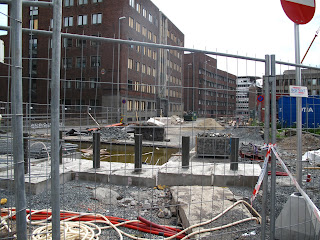
Perhaps these new bollards signal a new strategy in keeping vehicles off the route to important buildings and disallowing parking on such streets. In fact, in the aftermath of these attacks, a great many streets in Oslo have been closed to traffic while investigation, demolition, and reconstruction take place. It may now be a good time for the city to look at the benefits of pedestrian streets from a newly relevant angle and reconsider the auto-driven habits that clog city streets with parking.
Interestingly, in the new experience of the city, I find these blockages not to reinforce a landscape of terror and fear, as they well could. The barriers are lightweight and transparent, seeming (much like the law system in Norway) more suggestive rather than prohibitive or restrictive. Rather than people attempting to bypass these barriers, they have not only been respected as limits but have also been turned into memorials by the people. What could easily be an oppressive sign of fear another place, here has been transformed into a beautiful sign of grief and unity.


I've written a more personal note to this event in my second blog here, so I will keep this commentary short. However, from an urban perspective, experiencing this event has noted the transformation of a city in grief. These gates to the destroyed areas have becomes nodes in the city collecting people. Construction staging has created extra pedestrian streets and an open view feeling to the process of reconstruction. Destruction in some areas is being memorialized. Small statues, steps, and gates throughout the city bear flowers in mourning and remind passersby that we are all together in facing this tragedy.


Deconstructivism at its (natural) best. This landscape is around the mountain peak Melfjellet in Nordland - an iron rich area of sedimentary rock. As the pictures (from June) note, the area is under snow cover much of the year, with the main traffic artery left unplowed through winter, accessible by only skiers and snowmobilers. The summer thaw reveals forms that could easily inspire or compete with the last decades in architectural deconstruction formal thought.


Having moved to Norway nearly two years ago, I've been noticing subtle differences in the (physical, natural and planned) landscape - from topography to plant species. Now realizing the need for a more structured study of such phenomena (if I am to work in landscape architecture here), I will turn some of my blogging to this focus.
Starting with a reflection on some photos - unstructured observations over the past year in Oslo, which I will attempt here to structure into the following categories: what nature has planted in the forest and on the islands/coast surrounding the city, then what people shop atthe market and plant within the city.
For now, Nature - forest:


The forest plays a huge role in the lives and culture of Norwegians - even here in the city. Each weekend or evening day of good (and sometimes bad) weather, people flock by public transit and autos to the many entry points to the 300 (+) square kilometers of forest that surrounds the city (Oslomarka). In the winter, ski trails abound under conifers punctuated by busy "hytta" 's selling sausages, waffles and coffee. In the summer, more trails appear for hikers and mountain bikers, ponds thaw for swimming and fishing. Plants here are layered, from framing dramatic scenes over the fjord, then entering species-specific groves and finding a multitude of smaller flowering plants tucked into the brush surrounding paths and creeks.
The city forests are one locale in Norway where people greet strangers happily - society coming together to mutual enjoy and benefit from the health provided by nature. The proximity of this resource may be the most incredible aspect of Oslo - one can go from a hip downtown cafe (sipping 6$ coffee) to stumbling over moose droppings in about 20 to 30 minutes using the local subway or bus lines.
In the meantime I play to try keeping tabs on both the downtown flower market and the local botanical garden to see what's in bloom through the seasons. This will require a bit more discipline in scheduling on my part.


