Rush hour today - the morning one, 7:40 am to be exact - I was on the tram into the city center when a curious passenger came into my generally oblivious field of vision. There was no obvious dirt or telltale smell that would have alerted me that the passenger was a bit different than others, but something about the fit of the coat and casual way they sat their bag on the visibly dirty tram floor caught my attention. My gaze would not have lingered on the person long except that I noticed them pick a fallen bandaid off the filthy floor and reapply it to their hand whence it had fallen. Curiousity, boredom, and the person being in my field of vision held me then captivated to watch as said passenger proceeded to open their backpack, remove one large can of beer and slip it ever so obviously into the opening of one of their leather gloves. If the bandaid reapplication made me a bit uncomfortable, the (quite illegal in Oslo) public beer drinking so early in the morning got the attention of others - people shifted uneasily in their seats, averted their eyes, and subtly inched whatever few centimeters were possible in the opposite direction.
It is not comfortable to encounter different people, particularly those so far from the social norms we're accustomed to. But, I believe that simple encounters like mine this morning helps urban residents to grow as people.. I think to myself: 'This is the urban condition!" - just as much as being able to go to a fair trade cafe, see an independant theater production, or follow a live international lecture series. The everday act of living in a city offers countless encounters will people whose descriptions, proclivities, and lives in general might be unfathomable to us. We share public transportation, in fact all kinds of public infrastructure with all kinds of people. And in a city as evolved as Oslo (at least for now,) we all share the same rights to public space.
Being able to live in and encounter all kinds of people in public space is important, so that we don't begin to forget or deny the problems that plague cities, so that we don't forget that the people with problems are humans too. Sure, it makes some people uncomfortable, and enough research has come to convenient solutions that say "similar children play together best" (more or less as the Norwegian saying goes), but if not in public spaces, then when and where else will the average resident come across people who are different than they, outside their friends' circle, their income class, or other ethno/religious/you-name-it-self-segregating-group? It is all too easy to fear the unknown and create the sense of a risk where there is actually only strangeness. The way I see it, the only counter to such fear is the learning experience offered by chance encounters in public space. Very few are going to go out of their way to have a conversation with a stranger (particularly a strange stranger), and they are very unlikely to suddenly drop by for a coffee, so it is only out in the public, in cities, that this learning chance is offered. By instead distancing and allowing the segregation into whatever types of people, all people - humans - are denied the reality of their own diversity. Perhaps if we all had to face the plagues of our society each day, more motivation and resources would be found to attack the roots of the problems (be they alcoholism, drug abuse, pyschological issues, poverty, or otherwise), rather than using resources to attempt a falsely clean and homogenous image in public spaces and the creation of gated communities.
Tuesday, February 3, 2015


Sunday, January 18, 2015
Others
We often take for granted that we know each other - the people around us in the world where we live. Beyond assumptions one may make of their neighbors are those who work to shape the places inhabited by others in the city. Traditionally urban planners and architects have attempted to - perhaps even been forced to - simplify the problem of complexity in the city - undercutting the tasks before them. The "public" is grouped into a neat term that characteristics and wishes can be assigned to, or it is divided into social groups to attribute some normative trends towards activities and different general preferences to work towards. Today, many of these professionals tout participation as a mode of hearing the peoples' voice (or that of the ubiquitous public) in projects and debates, but question remains if they are getting as much as they could from that forum.
For one, we know that public participation events often informs us of those who are particularly eager to dominate planning and development discussions. In both Norway and the US, this type provokes a familiar image of an aging or retired male or female, outspoken, and fueled by very precise personal interests that may or may not be related to the project at hand - cue whatever reaction is a professionally acceptable form of rolling eyes. Of course, we know that it is wrong to dismiss these types, no matter how difficult they make consensus building or decision-making. Still, I am not sure how often they are really heard, short of when they manage to rally others behind their cause. While many a planner and architect may dread the uncomfortable encounter with these types, I wonder if it isn't more of just those insights into specific people that we need.
As an academic, I can (fortunately) consider this proposition removed from the very practical need of making decisions and meeting deadlines. Nevertheless, I, for one, am not convinced that participation is a useful tool for decision-making - it is rarely as democratic, including, effective, or bottom-up as our theoretical ideals would have it. If we removed consensus building from public hearing goals yet continued to ask for participation, we might end up with an interesting array of perspectives. By inviting everyone to offer their view where everyone else could see it, perhaps we could form better ideas about whom the others actually are - of how little we understand about them, and just maybe, how professionals could find mediating ways to work amidst their local complexities.
There are plenty of academics more qualified than I researching this idea - trying to figure out the practical implications of, for example Chantal Mouffe's "agonism" - the inherent benefits that may come from open conflict and the true embrace of diversity (of opinion and of being) through pluralism. I think it is equally important for regular people (members of the public, if you will) to become aware of those around, the incredible diversity that is often paired with a lacking awareness of others - those other than each themselves. Therein lies the real value of the public sphere, and the reason it could be quite dangerous to lose it. Public life seems to be tottering towards filtering itself into like groups - on one hand through commercialization or privatization of public spaces and through computer algorithms showing us only the viewpoints we want to see in social media on the other. It is important that we support the few forums left where we might encounter strangers and different perspectives rather than allow each to enclose themselves in their familiar and fear the rest.
While planners and designers continue using participation techniques to attempt solving questions that usually actually fall under their own expertise, it would be interesting to instead see participation as a learning tool - where the professionals and all involved participants might come together to learn about each other. I am reminded now of a recent lecture in Oslo where the speaker said – we have to stop planning as if everyone is 30 years old and athletic! It seems quite likely that what is more important than everyone agreeing is actually bringing everyone to acknowledge their disagreements and more openly consider the motives that inspire each point of view.
We are all the same in the fact that we are each different. Tolerance of the other might not be achievable through consensus so much as it might be through open awareness, acknowledgement and consideration of differences.
Monday, September 24, 2012
Oslo, a City of Farmers?
It's been a busy summer, inching my way into Oslo's seemingly young scene surrounding the topics of urban development, design, and planning. At a 'urban and local development' conference a few months ago, a politician from Bergen challenged the room with an accusation that Oslo has never been urban. Local rivalry between Bergen (Norway's second city with its rich Hanseatic trade history) and Oslo aside, I have noticed repeats of this sentiment echoing with Oslo being called a "city of farmers" or even "accidentally urban."
These terms typically come under critical views of Oslo's development progress and the city's sometimes seemlingly inconsistent plans for the future. Densification and sustainability but everyone needs a parking place for their car and buildings shouldn't be placed too close together. Sometimes it does seem that many Oslo-ites aren't quite sure how to handle the mass of people coming into the city - neither in day-to-day life (read: Justin Bieber concert cripples downtown traffic) nor in planning for future growth. With Oslo being one of the fastest growing cities in Europe, it's an exciting time to be here.
The "city of farmers" analogy is one that has stuck with me this summer - not in the negative way the comment was perhaps first intended, but rather in wondering what it means to bring farmers into a city. I've been preoccupied with the stewardship of land - the connect between people and places, something that I often find lacking in urbanity. Farmers have the tradition and history of stewarding land, so I wonder if there is something in the mentality that could be collectively motivated in the city. Perhaps following this line of thought, an American artist here, Amy Franceschini, has succeeded in starting a provoking urban gardening project in the midst of infrastructure and construction - 'Herligheten'. I braved the awkwardly signed road detours and chain link fences and managed to find the entrance to it on my bicycle during last month's 'open Bjørvika' day.
These terms typically come under critical views of Oslo's development progress and the city's sometimes seemlingly inconsistent plans for the future. Densification and sustainability but everyone needs a parking place for their car and buildings shouldn't be placed too close together. Sometimes it does seem that many Oslo-ites aren't quite sure how to handle the mass of people coming into the city - neither in day-to-day life (read: Justin Bieber concert cripples downtown traffic) nor in planning for future growth. With Oslo being one of the fastest growing cities in Europe, it's an exciting time to be here.
The "city of farmers" analogy is one that has stuck with me this summer - not in the negative way the comment was perhaps first intended, but rather in wondering what it means to bring farmers into a city. I've been preoccupied with the stewardship of land - the connect between people and places, something that I often find lacking in urbanity. Farmers have the tradition and history of stewarding land, so I wonder if there is something in the mentality that could be collectively motivated in the city. Perhaps following this line of thought, an American artist here, Amy Franceschini, has succeeded in starting a provoking urban gardening project in the midst of infrastructure and construction - 'Herligheten'. I braved the awkwardly signed road detours and chain link fences and managed to find the entrance to it on my bicycle during last month's 'open Bjørvika' day.
 |
| The garden lies at the base of vent towers going down to the traffic tunnel below. |
 |
| Proximity to Bjørvika, one of Oslo's main development zones on the fjord front. |
 |
| There are 100 plot boxes in total, not many people were working them this day. |
 |
| ...but, things were growing! |
Friday, May 4, 2012
Aesthetic Differences
Now that spring has arrived, my preoccupation has been in urban gardening. My own window sill is full of small-scale cultivation attempts which have finally also taken over a small portion of our fire balcony. I have been following a local initiative to encourage organic urban gardens and localized food production - MAJOBO (Mat og Jord der du Bor, or "Food and Earth where you Live"). Participants and enthusiasts in this group seem to agree in being more concerned about the health and nutrition of the land and production than the traditional aesthetic expected of the garden, as can be seen in various dialogues regarding weeds. These conversations generally follow a pattern:
Q - But how do you keep weeds away without chemicals?
A1 - They are only weeds if you don't want them - plenty of "weeds" are useful, edible, beautiful, etc.
A2 - Planting the right density of the right species will naturally inhibit unwanted growth.
A3 - Get in there and pull them out yourself!
The community and their knowledge is fascinating to me - it is great as a beginner in urban gardening to have such an accessible local resource base. Of course, as with most topics in urbanity, it is naive to assume that everyone in the hobby of gardening gets along. I have recently encountered a situation where the spirits of organic and guerrilla gardening are being challenged by a post-war structured flower bed mentality.
It all began in a Gamle Oslo housing cooperative whose lawn and land area are perhaps equal again to the building footprint. A long term resident has developed and nurtured a series of flower beds over her tenancy - each spring buying and transplanting flowers in bloom and weeding out any 'out of place' species to beautify the property. A few years ago, a friend of mine with an incredible passion for plants moved into the cooperative with her husband and asked permission to garden in an unused swath at the property's edge - between a fence and a row of hedges. With permission, she cleared the long swath, added edging and a retaining wall and began planting. Strawberries, arugula, peas, chives, and tomatos grew interspersed with some herbs and flower bulbs. The planting was dense, following a natural aesthetic and many of the species would take years to establish blooms.

A couple growing seasons passed, then came an interference. My friend went out to survey the plot for this year's season and noticed several of her plants had been removed and some blooming flowers had been recently relocated into the bed. Beyond this, the chive stalks had been torn unevenly and the nozzle had been cut off of the garden hose. Conversation with the flower bed gardener uncovered an ongoing (and priorly passive) agression, complete with protests that my friend's garden swath was an eyesore and full of weeds. The other gardener admitted to moving and removing several plants, but it seems that responsibility for the hose and chive harvesting lay elsewhere - potentialy in a passerby. The most intact part of the garden remaining is pictured above with a currant bush, some wintered timian, and yes, a bit of actual weeding to be done.
These are the frustrations of urban gardening - beyond worrying about the plants, we have also to worry about all the other species around - especially fellow humans. While I had hoped to be introduced to this Gamle Oslo garden and see it as a potential pilot project that other property owners could learn from, I am instead introduced (yet again) to the complexities of dense cohabitation.
At this point there are a few potentials for this garden swath asides from neglecting it completely. Depending on how much the adjacent hedges now shade the land, some species may be introduced and the garden continued as before - with perhaps enough camoflage provided by the hedges to appease the neighbor gardener. It seems prudent if planting harvest-ables, that they should perhaps favor roots or vegetables that are more difficult to access. Another tempting idea is to cover the swath in a local type of nettle - which can be eaten similarly to spinach or made into tea - with the added benefit of discouraging meddling.
However, none of these options are particularly conducive to mitigating the neighbor relations. These types of opinion conflicts were quite prevalent in my thesis on communal urban spaces here and work to prevent change. As long as the concept of space personalization and aesthetic differences are at play, consensus and community are difficult goals to achieve. I find myself wondering if an introduction to permaculture would benefit the boards of such housing cooperatives or if the attitudes that support asphalt surfaces, expansive lawns, and weedkiller chemicals run too strongly for reason or change.
Q - But how do you keep weeds away without chemicals?
A1 - They are only weeds if you don't want them - plenty of "weeds" are useful, edible, beautiful, etc.
A2 - Planting the right density of the right species will naturally inhibit unwanted growth.
A3 - Get in there and pull them out yourself!
The community and their knowledge is fascinating to me - it is great as a beginner in urban gardening to have such an accessible local resource base. Of course, as with most topics in urbanity, it is naive to assume that everyone in the hobby of gardening gets along. I have recently encountered a situation where the spirits of organic and guerrilla gardening are being challenged by a post-war structured flower bed mentality.
 |
| Property yard overview - photo from Google Maps Streetview. |
It all began in a Gamle Oslo housing cooperative whose lawn and land area are perhaps equal again to the building footprint. A long term resident has developed and nurtured a series of flower beds over her tenancy - each spring buying and transplanting flowers in bloom and weeding out any 'out of place' species to beautify the property. A few years ago, a friend of mine with an incredible passion for plants moved into the cooperative with her husband and asked permission to garden in an unused swath at the property's edge - between a fence and a row of hedges. With permission, she cleared the long swath, added edging and a retaining wall and began planting. Strawberries, arugula, peas, chives, and tomatos grew interspersed with some herbs and flower bulbs. The planting was dense, following a natural aesthetic and many of the species would take years to establish blooms.
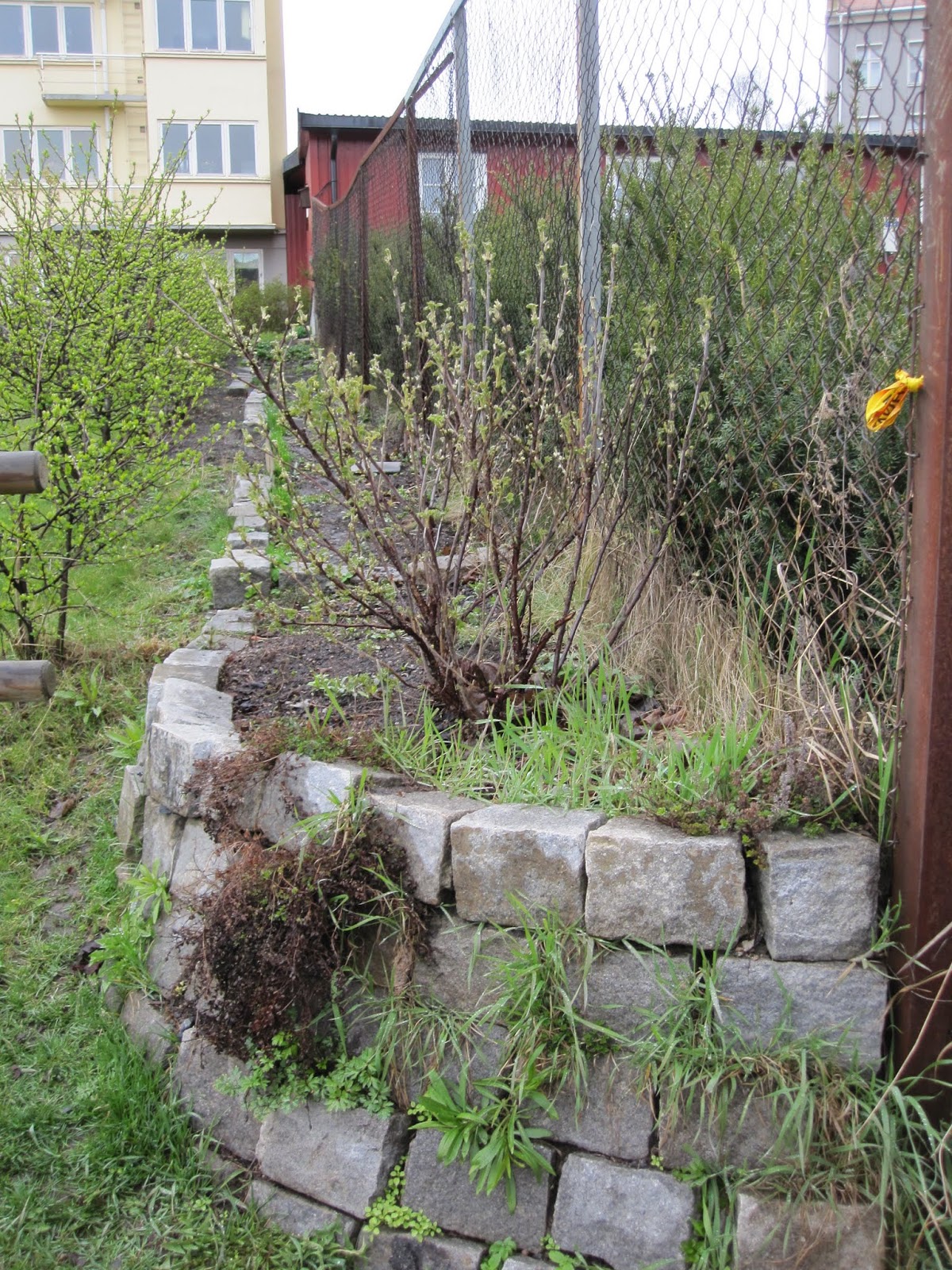
A couple growing seasons passed, then came an interference. My friend went out to survey the plot for this year's season and noticed several of her plants had been removed and some blooming flowers had been recently relocated into the bed. Beyond this, the chive stalks had been torn unevenly and the nozzle had been cut off of the garden hose. Conversation with the flower bed gardener uncovered an ongoing (and priorly passive) agression, complete with protests that my friend's garden swath was an eyesore and full of weeds. The other gardener admitted to moving and removing several plants, but it seems that responsibility for the hose and chive harvesting lay elsewhere - potentialy in a passerby. The most intact part of the garden remaining is pictured above with a currant bush, some wintered timian, and yes, a bit of actual weeding to be done.
These are the frustrations of urban gardening - beyond worrying about the plants, we have also to worry about all the other species around - especially fellow humans. While I had hoped to be introduced to this Gamle Oslo garden and see it as a potential pilot project that other property owners could learn from, I am instead introduced (yet again) to the complexities of dense cohabitation.
At this point there are a few potentials for this garden swath asides from neglecting it completely. Depending on how much the adjacent hedges now shade the land, some species may be introduced and the garden continued as before - with perhaps enough camoflage provided by the hedges to appease the neighbor gardener. It seems prudent if planting harvest-ables, that they should perhaps favor roots or vegetables that are more difficult to access. Another tempting idea is to cover the swath in a local type of nettle - which can be eaten similarly to spinach or made into tea - with the added benefit of discouraging meddling.
However, none of these options are particularly conducive to mitigating the neighbor relations. These types of opinion conflicts were quite prevalent in my thesis on communal urban spaces here and work to prevent change. As long as the concept of space personalization and aesthetic differences are at play, consensus and community are difficult goals to achieve. I find myself wondering if an introduction to permaculture would benefit the boards of such housing cooperatives or if the attitudes that support asphalt surfaces, expansive lawns, and weedkiller chemicals run too strongly for reason or change.
Tuesday, April 3, 2012
Bicycle friendly?
I hope these bicycle racks looked nice on someone's drawing at least. I found a way behind the trash and up two stairs to lock my bike with minimal disturbance to the perpetually feeding pigeons. (@ Youngstorget, Oslo)
Tuesday, February 21, 2012
Traffic machine vs. Human machine
I took a walk down to Oslo's ever-developing neighborhood of Bjørvika the other day - primarily to get some pictures of the de-constructing of the Bispelokket "trafikkmaskin." Literally called a "traffic machine" in Norwegian, it was a series of stacked rotaries that handled the highway seeking traffic along the Oslo fjord over the last 40 to 50 years. Not unlike the Big Dig project in Boston, this raised construction has been replaced with a traffic tunnel, so its demolition has been planned as a part of this new neighborhood development that is meant to connect the Opera district with the rest of the city.
The pedestrian and automobile routes to, around, and from this current construction site continues to perplex Oslo residents. People are rerouted on a daily basis, with a variety of signage that describes the circuitous at best detours. I found myself somewhat amused at the physical effort currently required of a pedestrian to make a simple loop around the new neighborhood. It all began with the need to cross a road, which is no longer just a road but a multi-lane rotary.

And then the solution for it..
It seems that we've gone from ramping cars out of the way overhead in the traffic machine, to this solution I am naming the human machine - ramping pedestrians up and over traffic. Of course the resulting view gives an interesting perspective on the otherwise un-crossable road.

Eventually on the other side I came to the site of the old Bispelokket - where not much of it is still intact.

The pedestrian and automobile routes to, around, and from this current construction site continues to perplex Oslo residents. People are rerouted on a daily basis, with a variety of signage that describes the circuitous at best detours. I found myself somewhat amused at the physical effort currently required of a pedestrian to make a simple loop around the new neighborhood. It all began with the need to cross a road, which is no longer just a road but a multi-lane rotary.

And then the solution for it..
 |
| The ramp and bridge to the left crosses the rotary directly to the front. |
It seems that we've gone from ramping cars out of the way overhead in the traffic machine, to this solution I am naming the human machine - ramping pedestrians up and over traffic. Of course the resulting view gives an interesting perspective on the otherwise un-crossable road.

Eventually on the other side I came to the site of the old Bispelokket - where not much of it is still intact.

Behind the Opera this and other construction has taken over for the time being. Pedestrians who are typically put first on Norwegian roadways are channeled between concrete barriers and reminded to watch for turning traffic.
 |
| The sign here says "Careful! Does the car see you?" |
 |
| Traffic to be crossed between the Opera plaza and the next pedestrian bridge. |
 |
| View over old Bispelokket site from Opera's pedestrian bridge. |
These aspects of planning and engineering the movement of traffic and humans in machines brings the 1920s German movie Metropolis to mind. There is something particular dystopian about development, especially while it is underway. It is difficult to look at this site today and imagine that in the future it is to be a progressive pedestrian friendly neighborhood that will magically connect the new buildings along the fjord to the existing urban fabric behind the train tracks.
 |
| The plaza in front of the Opera currently stands as a pedestrian friendly island amidst chaos. |
More photos from this site here.
Wednesday, February 15, 2012
'How should Oslo be?'
Last night at Oslo's center for design and architecture (DogA) opened an exhibition on the conceptual and actual planning for the future growth of the city. The day before, a news article covered one set of concept projects by MVRDV plus some local offices, which were meant largely designed to provoke. As seems to be the trend in urban planning, the questions are very clear but the solutions less so.
I was struck first by the article with MVRDVs proposals. They cleverly cover a great deal of the city and surrounding districts with variations of feasibility. Many of the options suggest densifying and/or developing national landmarked parks and other points of interest which has made for intriguing local debates. In the end, I cannot help feeling a bit underwhelmed by the work. Somehow it seems that the richest country on the planet with some of the most progressive environmental policies might be able to push for something new. These published "solutions" instead transport me directly back my undergrad education flipping through Koolhaas' 1998 book S, M, L, XL. Then the forms, graphics, and principles seemed new and innovative, but I cannot identify any points of departure from urbanism in the late 90s and that of today - nearly 15 years later.
Other proposals held a great deal of emphasis on the development of infrastructure and the creation of small villages in the areas around Oslo. While I appreciate that these villages took an amount of density, services and public transportation into account, I am not sure that they will lead to anything different from American sprawl.
I cannot help but notice many missed opportunities already existing in Oslo proper which may or may never be addressed. Some friends of mine live near the forest border in the north. Their neighborhood is served by several public bus lines - it is less than a 20 minute ride to the city center, a 5 minute walk to the forest trails, but it is nearly 15 minutes walk to the nearest grocery store. There are many preschools, some sports fields, but not a single cafe or restaurant. The address is Oslo, but the lifestyle quickly becomes that of a suburb - cars seem more useful than the buses and both vehicles in mass compete dangerously with bicyclists, skaters, and joggers along the one major traffic route that has never held a sidewalk.
The new village development plans shown in the exhibition hope to address such concerns for new neighborhoods, but what will happen to the current ones? Rather than maps of transportation corridors and ring roads and walking distance to train stations, I think it might be a good time to think about a different scale. It would likely paint an amazingly unsustainable picture if we looked at Oslo from the current location of other services to population density. How far must people commute to work, yes, but also how far must people commute to the grocery store? If we want to densify Oslo, part of the solution should be including all the services that draw people to, and support them within, a place. Allow and encourage the elements that draw people to new developments in the existing ones - if we can make more people want to live in existing neighborhoods then density will come on its own. In my opinion it would promote healthier growth to add a post office, cafe, and market to an existing residential neighborhood and let the next farm over contribute to the food supply instead of the residential footprint of the city.
 |
| MVRDV image from Aftenposten, ring of high rises around city center. Source: http://ap.mnocdn.no/incoming/article6759467.ece/ALTERNATES/w780c169/FS00015036.jpg?updated=110220121826 |
I was struck first by the article with MVRDVs proposals. They cleverly cover a great deal of the city and surrounding districts with variations of feasibility. Many of the options suggest densifying and/or developing national landmarked parks and other points of interest which has made for intriguing local debates. In the end, I cannot help feeling a bit underwhelmed by the work. Somehow it seems that the richest country on the planet with some of the most progressive environmental policies might be able to push for something new. These published "solutions" instead transport me directly back my undergrad education flipping through Koolhaas' 1998 book S, M, L, XL. Then the forms, graphics, and principles seemed new and innovative, but I cannot identify any points of departure from urbanism in the late 90s and that of today - nearly 15 years later.
Other proposals held a great deal of emphasis on the development of infrastructure and the creation of small villages in the areas around Oslo. While I appreciate that these villages took an amount of density, services and public transportation into account, I am not sure that they will lead to anything different from American sprawl.
I cannot help but notice many missed opportunities already existing in Oslo proper which may or may never be addressed. Some friends of mine live near the forest border in the north. Their neighborhood is served by several public bus lines - it is less than a 20 minute ride to the city center, a 5 minute walk to the forest trails, but it is nearly 15 minutes walk to the nearest grocery store. There are many preschools, some sports fields, but not a single cafe or restaurant. The address is Oslo, but the lifestyle quickly becomes that of a suburb - cars seem more useful than the buses and both vehicles in mass compete dangerously with bicyclists, skaters, and joggers along the one major traffic route that has never held a sidewalk.
The new village development plans shown in the exhibition hope to address such concerns for new neighborhoods, but what will happen to the current ones? Rather than maps of transportation corridors and ring roads and walking distance to train stations, I think it might be a good time to think about a different scale. It would likely paint an amazingly unsustainable picture if we looked at Oslo from the current location of other services to population density. How far must people commute to work, yes, but also how far must people commute to the grocery store? If we want to densify Oslo, part of the solution should be including all the services that draw people to, and support them within, a place. Allow and encourage the elements that draw people to new developments in the existing ones - if we can make more people want to live in existing neighborhoods then density will come on its own. In my opinion it would promote healthier growth to add a post office, cafe, and market to an existing residential neighborhood and let the next farm over contribute to the food supply instead of the residential footprint of the city.
Thursday, January 5, 2012
Oslo's Almost Pedestrian Street
I took my bicycle out to run some errands today. It is the beginning of January and I am in Oslo, but don't imagine that I was braving a blizzard with ice pegs on my tires (I will never be Norwegian enough for this). It has been a surprisingly mild winter this year; a couple icy spots are left over undrained puddles, but I was more than warm and safe enough to take on the environment after donning just a wool shirt, down vest, and lined leather gloves.
The bizarre part of this story began when, having the luxury of time, I decided to try taking actual bike lanes home. Oslo is not known for being bike-able and it seems to have a surprisingly long way to go compared to other Scandinavian capitals. Drivers are extremely pedestrian careful here, but on a bicycle it is a different story. Bike lanes start and end without reason or warning and cars (and bicyclists) often pretend not to notice their existence. On my (ten minute) detoured ride home, I encountered the following episodes.
First on Torggata - a street which this year received almost all the makings of a great pedestrian way - I found myself having to swerve twice around the same car who was apparently attempting a three-point U-turn or two and backing up parking-spot-seeking-traffic in several directions. Watching the timid 'pedestrianization' moves of the eastern half of Torggata has been rather excruciating. A few steps forward resulting in several steps back. The two ends of the stretch have been blocked off with bollards and markings for bicycle lanes, but the several blocks between this are basically open to traffic from side streets, loading and parking in particular. If you have ever been a pedestrian or bicyclist walking in a shopping street or parking lot, you may understand how uncomfortable (and actually dangerous) it is to be unsuspectingly adjacent to cars and trucks in the midst of parking maneuvers. Either there is a phase not yet implemented in this project, or this confusing-to-all result has entirely escaped the attention of the street's planners.
Continuing on my bicycle after this street I was continually surprised - turning onto streets that I was certain held bike lanes only to find that the end of the street where I had entered the street indeed did not. At one point in the middle of a bridge's car lane, I had to challenge a pedestrian carrying a guitar case for position because the sidewalks were apparently slippery. Finally, on the home stretch I was preparing to take a left onto the last marked bike lane home and I encountered two police women on horseback wearing hijab under reflective safety vests - why didn't I have my camera with me?!
So if I was a bit confused about bicycle etiquette in Oslo before, I was then at a complete loss of how to share the bicycle lane with horses. Instead of attempting to use it and pass them, I remained on the wrong side of the street and defeated-ly rode the final length on the sidewalk. People often ask me what I miss from living in New York, and they probably expect a whole host of answers. My typical (automatic) response is food related, but these days I really wish Oslo had a RideTheCity website!
The bizarre part of this story began when, having the luxury of time, I decided to try taking actual bike lanes home. Oslo is not known for being bike-able and it seems to have a surprisingly long way to go compared to other Scandinavian capitals. Drivers are extremely pedestrian careful here, but on a bicycle it is a different story. Bike lanes start and end without reason or warning and cars (and bicyclists) often pretend not to notice their existence. On my (ten minute) detoured ride home, I encountered the following episodes.
First on Torggata - a street which this year received almost all the makings of a great pedestrian way - I found myself having to swerve twice around the same car who was apparently attempting a three-point U-turn or two and backing up parking-spot-seeking-traffic in several directions. Watching the timid 'pedestrianization' moves of the eastern half of Torggata has been rather excruciating. A few steps forward resulting in several steps back. The two ends of the stretch have been blocked off with bollards and markings for bicycle lanes, but the several blocks between this are basically open to traffic from side streets, loading and parking in particular. If you have ever been a pedestrian or bicyclist walking in a shopping street or parking lot, you may understand how uncomfortable (and actually dangerous) it is to be unsuspectingly adjacent to cars and trucks in the midst of parking maneuvers. Either there is a phase not yet implemented in this project, or this confusing-to-all result has entirely escaped the attention of the street's planners.
 |
| Torggata street end "closure" to car traffic, looks like a bike lane. |
 |
| Pedestrian use of Torggata this summer. |
 |
| Great pedestrian street elements and... parking?! |
Continuing on my bicycle after this street I was continually surprised - turning onto streets that I was certain held bike lanes only to find that the end of the street where I had entered the street indeed did not. At one point in the middle of a bridge's car lane, I had to challenge a pedestrian carrying a guitar case for position because the sidewalks were apparently slippery. Finally, on the home stretch I was preparing to take a left onto the last marked bike lane home and I encountered two police women on horseback wearing hijab under reflective safety vests - why didn't I have my camera with me?!
So if I was a bit confused about bicycle etiquette in Oslo before, I was then at a complete loss of how to share the bicycle lane with horses. Instead of attempting to use it and pass them, I remained on the wrong side of the street and defeated-ly rode the final length on the sidewalk. People often ask me what I miss from living in New York, and they probably expect a whole host of answers. My typical (automatic) response is food related, but these days I really wish Oslo had a RideTheCity website!
Friday, November 11, 2011
A Landscape of Litigation
I liked London - it's a quintessential big city with both quintessential urban possibilities and urban problems. Arriving there from Oslo made me re-aware of a few things - 1) Oslo really is a very small city, 2) the UK really is the older cultural/governmental ancestor of the US, and 3) we from the US - along with those from the UK - actually grow up within a landscape that demonstrates a culture of litigation.
I'm well accustomed to the visual onslaught of signage and advertising typical to cities, but coming from Norway I was not exactly prepared for the blatant commands constantly surrounding, advising, and guiding people in London. Nearly every intersection tells pedestrians which way to look, plus when, where, and how to cross traffic. Traffic is guided by more signage and all is enforced with a multitude of security/safety/surveillance cameras.
The contrast is in the details perhaps. Norway has similar traffic rules, and even an amount of signage to reinforce them. They do not, however, typically use wording on the signs, and in many cases the rules are stated and understood more as healthy suggestions rather than mandates. The impressive part of this contrast (to me) is that most Norwegians will not cross a busy road without the pedestrian signal, while Londoners (and those from most American cities I've seen) are commonly spotted dashing through any traffic gaps - despite blatant warnings all around.
While I didn't set out on this trip to document the signage, browsing through my trip photos I see that I have inadvertently still captured a series of the conditions which struck me.


My favorite from signage spotting in London was the graffiti stencil over the 'do not enter' sign above (one of the few signs there that do not write out its meaning in verbiage). This guy spotted throughout the city reminds me that while the UK may be the birthplace of many establishments that tend towards the conservative and outdated, but it was also home to much of the punk movement.
Sunday, October 16, 2011
Finland: Lapland Landscape
Some photos from the bus window on the road between Rovaniemi and Kilpisjarvi, Finland.


Thursday, September 29, 2011
Hiking With Reindeer and Robots
Some fellow creatures on a hike that took place around here.
Robot by Niki Passath.
Reindeer by.. mother nature?
Tuesday, September 27, 2011
Natural Reactions
I've landed in Lapland of Northern Finland for a week workshop/think tank to consider the relationship between humans and nature. In the dialogues (between artists, scientists, and those of us who fall un-categorically between), we make the point of understanding humans as a part of nature - reversing "scientific" thought of removing oneself from the equation. Already on the first day, some interesting points have come up and I believe that I'm starting to reshape (or sharpen the focus of) my perspectives on sustainability.
One question from this morning was - since we humans are looking at nature and attempting to learn from what we deem as 'positive' or 'effective' qualities, do other objects in nature do this? Butterflies move their wings when hanging on trees to resemble leafs when predators are near without any cognitive ability to consciously know that their movement protects them. We had read some Darwin in the build up to the program, and we (as humans) tend to believe that plants and non-conscientious species adapt in reactive ways to somehow better themselves/the future of their species. An interesting note here is the habit of separating humans from the rest, but perhaps we too are simply reacting to our surroundings.
There has been a lot of talk about human impacts and how to mitigate the disturbances to ecosystems that we are causing - from lessening our consumption, to the potentials of creating new species to replace those that go extinct. There is a wide range of backgrounds and expertise at this workshop which bring a lot of new perspectives, reactions, and possibilities together (for better or worse). A point can be made in looking objectively at the human species on the planet that we are a biological case of overpopulation - a simple scientific thought with very complex ethical implications.
Fortunately so far, humans are not subscribing to the prescription of culling that we use when other species overpopulate an area and ruin resource bases or cause pollution (as you hear of for deer perhaps), but many are realizing that our impact must be lessened. Many people like to argue for or against sustainability as some kind of human duty to the planet, but I am realizing it can also be seen as a human duty to humans. Sustainability is a reaction the human species is developing to a threat - adaptations to species and to life habits are necessary if we are to continue to survive at current or projected population levels. Some questions remain in do we try to change ourselves, or do we try to change the world around us to accommodate us, or are both approaches necessary for the planet to support us?
One question from this morning was - since we humans are looking at nature and attempting to learn from what we deem as 'positive' or 'effective' qualities, do other objects in nature do this? Butterflies move their wings when hanging on trees to resemble leafs when predators are near without any cognitive ability to consciously know that their movement protects them. We had read some Darwin in the build up to the program, and we (as humans) tend to believe that plants and non-conscientious species adapt in reactive ways to somehow better themselves/the future of their species. An interesting note here is the habit of separating humans from the rest, but perhaps we too are simply reacting to our surroundings.
There has been a lot of talk about human impacts and how to mitigate the disturbances to ecosystems that we are causing - from lessening our consumption, to the potentials of creating new species to replace those that go extinct. There is a wide range of backgrounds and expertise at this workshop which bring a lot of new perspectives, reactions, and possibilities together (for better or worse). A point can be made in looking objectively at the human species on the planet that we are a biological case of overpopulation - a simple scientific thought with very complex ethical implications.
Fortunately so far, humans are not subscribing to the prescription of culling that we use when other species overpopulate an area and ruin resource bases or cause pollution (as you hear of for deer perhaps), but many are realizing that our impact must be lessened. Many people like to argue for or against sustainability as some kind of human duty to the planet, but I am realizing it can also be seen as a human duty to humans. Sustainability is a reaction the human species is developing to a threat - adaptations to species and to life habits are necessary if we are to continue to survive at current or projected population levels. Some questions remain in do we try to change ourselves, or do we try to change the world around us to accommodate us, or are both approaches necessary for the planet to support us?
 |
| road art between Rovaniemi and Kilpisjaarvi |
Thursday, September 22, 2011
Oslo Urbanism
I have noticed some seasonal effects to my blog writing - namely, that during the winter the weather and snow cover makes many observations difficult and that during the summer the weather and sunshine make sitting at a computer to write difficult. Keeping this in mind, I've spent a summer enjoying Oslo and taking photos, making mental notes of things to write about. Now that autumn has arrived in it's chilly gray splendor, I am finding some quality computer time to go back over those photos and thoughts.
In general, it seems like urbanism is a new, but snowballing concept for Oslo. Norwegians are not accustomed to density, but the pressures are here and they're growing at a rapid pace. Globalization and rising populations are happening here as in any other world city, but there are some Oslo specific geographical aspects that currently prohibit sprawl. Oslo is located on a fjord and otherwise surrounded by an incredible >300 sq km cover of hilly forest. The forests are protected, and they are building into the water but for the most part, densification is the answer. It is interesting to watch the construction trends and see the car mentality of the last decades clashing with the progressive hopes for a sustainable city.
I am certain to come back with more detail on this topic later, but for now I offer two takes on pedestrianization.
In general, it seems like urbanism is a new, but snowballing concept for Oslo. Norwegians are not accustomed to density, but the pressures are here and they're growing at a rapid pace. Globalization and rising populations are happening here as in any other world city, but there are some Oslo specific geographical aspects that currently prohibit sprawl. Oslo is located on a fjord and otherwise surrounded by an incredible >300 sq km cover of hilly forest. The forests are protected, and they are building into the water but for the most part, densification is the answer. It is interesting to watch the construction trends and see the car mentality of the last decades clashing with the progressive hopes for a sustainable city.
 |
| The future waterfront of Oslo with Bjørvika's center extension. |
I am certain to come back with more detail on this topic later, but for now I offer two takes on pedestrianization.
 |
| Torggata - the almost pedestrian street. |

 |
| Bar Code Area plaza and pedestrian bridge in background (urban design by MVRDV and others) |
 |
| The pedestrian bridge, currently linking a gas station with a construction site over the train tracks, someday will connect the new "Opera Quarter" with whatever post-gentrification brings to (currently multicultural, working class) Grønland. |
Tuesday, August 16, 2011
The Other Side of the Street
As often happens on a subtler scale, a few disconnected influences coincided over the past week which kicked off the thought process behind this blog entry.
First, I've been reading - in Norwegian - a book about the ongoing gentrification process in a section of my Oslo neighborhood which is becoming less and less known by the name 'Little Pakistan.' The book is called Tøyengata and written by a human geographer named Tone Huse who has conducted a research project somewhat similar to my thesis fieldwork, just five years or so prior. In the process of describing the neighborhood, Huse writes about the bias of both the passerby and of the researcher in a multicultural, largely Muslim neighborhood of a westernized city. To (somewhat poorly) translate and paraphrase, she writes that it is easy in this setting for one to allow themselves to be lead to misunderstandings, being blinded by the apparent foreignness of it all (the women in hijab, the asian pastry cafes, the exotic vegetable markets and the fabric shops).
"Miljoet er ikke ens egen. Og selv om en skulle være del av ett av Tøyengatas miljøer, er andre sider ved gata fremdeles ukjente." She writes that that environment is not one's own, and that even when you are a part of one of the street's communities, other side of the street remains unknown. Huse's words strike a resonance with me because I have been that passerby, that researcher, and I continue to be that resident misfit as I am now marking the end of my first year of living in Tøyen. Each day I leave my apartment and am confronted with cultures I know little about. Immigrant families in my neighborhood come from countries as far removed from Norway as Somalia, Iraq, Afghanistan and Pakistan. I feel like I learn a bit about these people each day, and each day I wonder more. We shop together in the markets and share public spaces and public amenities - in many cases we also share at least a second language knowledge (in my case) of Norwegian, but our lives rarely intersect.
In general, I greatly enjoy my neighborhood. In my personal, subtle ongoing cultural experiment of smiling to passersby on city streets, I quickly found that my smiles and nods are more often returned here than amongst higher native Norwegian populations nearby. Shopkeepers here strike up conversation and small communities develop around where people buy their vegetables. Despite these pleasantries, it is sometimes difficult to shake the perceptions of difference from all sides - boundaries do exist between groups of people here. There are stores and prayer rooms only frequented by the Somalian or the Pakistani populations, and there are local pubs only used by an older Norwegian crowd of regulars. These differences and boundaries can be frustrating to get past, but I find the interactions that happen in the spaces between to be of both great interest and of great potential as an urbanist and as a resident.
I think about these themes often, but they have seemed especially relevant in the aftermath of the 22 July attacks on Oslo and the heightened aftermath awareness of risks associated with prejudice. A Norwegian friend of mine shared a moving story on her blog about overhearing an account of Utøya from a surviver on a bus, with the poignant lesson of how we can never (and should never attempt to) know anything about a person at first sight, without hearing who they are, what they've been through, or what they aspire to.
These messages seem particularly important to me lately as well, while the political arena in the US reels. I'm afraid that sometimes it's all too easy for us as humans to forget humanity. Whether differences lie in opinions, ethnicities, social statuses or other realms, they are irrelevant at the end of the day. As humans, we are the same at the core and we hold the same basic needs and aspirations across our outward appearances and expressions. Political debates and pointing fingers against ideologies, immigration policies, or religious practices accomplish nothing towards what should be the greater goal of making society stronger and more sustainable.
I was contacted about my blog entry after the Oslo attacks via email by a film project called My Fellow American, which seeks to recognize the Muslim community in the United States as any other neighbors, any other group of citizens. To help them spread their message, I'm sharing their film at the bottom of this post. The point follows the the same in the US as in Oslo and Norway, as much as anywhere across the world. It seems to me that the understanding of our potential misunderstandings may be the key to cultural pluralism.
First, I've been reading - in Norwegian - a book about the ongoing gentrification process in a section of my Oslo neighborhood which is becoming less and less known by the name 'Little Pakistan.' The book is called Tøyengata and written by a human geographer named Tone Huse who has conducted a research project somewhat similar to my thesis fieldwork, just five years or so prior. In the process of describing the neighborhood, Huse writes about the bias of both the passerby and of the researcher in a multicultural, largely Muslim neighborhood of a westernized city. To (somewhat poorly) translate and paraphrase, she writes that it is easy in this setting for one to allow themselves to be lead to misunderstandings, being blinded by the apparent foreignness of it all (the women in hijab, the asian pastry cafes, the exotic vegetable markets and the fabric shops).
"Miljoet er ikke ens egen. Og selv om en skulle være del av ett av Tøyengatas miljøer, er andre sider ved gata fremdeles ukjente." She writes that that environment is not one's own, and that even when you are a part of one of the street's communities, other side of the street remains unknown. Huse's words strike a resonance with me because I have been that passerby, that researcher, and I continue to be that resident misfit as I am now marking the end of my first year of living in Tøyen. Each day I leave my apartment and am confronted with cultures I know little about. Immigrant families in my neighborhood come from countries as far removed from Norway as Somalia, Iraq, Afghanistan and Pakistan. I feel like I learn a bit about these people each day, and each day I wonder more. We shop together in the markets and share public spaces and public amenities - in many cases we also share at least a second language knowledge (in my case) of Norwegian, but our lives rarely intersect.
In general, I greatly enjoy my neighborhood. In my personal, subtle ongoing cultural experiment of smiling to passersby on city streets, I quickly found that my smiles and nods are more often returned here than amongst higher native Norwegian populations nearby. Shopkeepers here strike up conversation and small communities develop around where people buy their vegetables. Despite these pleasantries, it is sometimes difficult to shake the perceptions of difference from all sides - boundaries do exist between groups of people here. There are stores and prayer rooms only frequented by the Somalian or the Pakistani populations, and there are local pubs only used by an older Norwegian crowd of regulars. These differences and boundaries can be frustrating to get past, but I find the interactions that happen in the spaces between to be of both great interest and of great potential as an urbanist and as a resident.
I think about these themes often, but they have seemed especially relevant in the aftermath of the 22 July attacks on Oslo and the heightened aftermath awareness of risks associated with prejudice. A Norwegian friend of mine shared a moving story on her blog about overhearing an account of Utøya from a surviver on a bus, with the poignant lesson of how we can never (and should never attempt to) know anything about a person at first sight, without hearing who they are, what they've been through, or what they aspire to.
These messages seem particularly important to me lately as well, while the political arena in the US reels. I'm afraid that sometimes it's all too easy for us as humans to forget humanity. Whether differences lie in opinions, ethnicities, social statuses or other realms, they are irrelevant at the end of the day. As humans, we are the same at the core and we hold the same basic needs and aspirations across our outward appearances and expressions. Political debates and pointing fingers against ideologies, immigration policies, or religious practices accomplish nothing towards what should be the greater goal of making society stronger and more sustainable.
I was contacted about my blog entry after the Oslo attacks via email by a film project called My Fellow American, which seeks to recognize the Muslim community in the United States as any other neighbors, any other group of citizens. To help them spread their message, I'm sharing their film at the bottom of this post. The point follows the the same in the US as in Oslo and Norway, as much as anywhere across the world. It seems to me that the understanding of our potential misunderstandings may be the key to cultural pluralism.
Film: My Fellow American - linked from youtube.com
Thursday, July 28, 2011
A Landscape of Grief
 Photo by Øyvind Tveter, found: http://cache.20minutes.fr/img/photos/20mn/2011-07/2011-07-22/article_oslo.jpg
Last Friday, when I first saw images published by Aftenposten such as the one above, one of my early thoughts after the horror passed was the irony of the bollards at this site. Having worked on various security landscape projects, I've held an amount of skepticism to the overwhelming number of bollards planted in the world, particularly in the past decade. Engineers tell us that these steel and metal forms can stop a vehicle carrying explosives in the event of a terror attack, keeping blasts from damaging the structural components of a building.
Seeing the aftermath of a car-borne blast outside the bollard zone here makes me question how much these stanchions actually help. While the building has not fallen down, it seems unlikely that it will be ever occupied in this form again. Further, rumors of possible structural instability have been circulated in the news, explaining added difficulty to the search and rescue process - so what actually have the bollards in all their perimeter multitude accomplished?
I ask this question more so now, after visiting the area surrounding the bombed site the other day. I took this photo of what seems to be new bollards going into place, effectively blocking the road to the targeted government building.
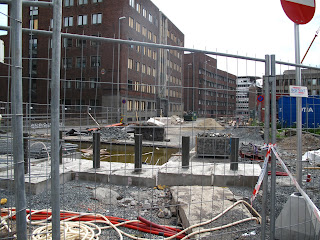
Perhaps these new bollards signal a new strategy in keeping vehicles off the route to important buildings and disallowing parking on such streets. In fact, in the aftermath of these attacks, a great many streets in Oslo have been closed to traffic while investigation, demolition, and reconstruction take place. It may now be a good time for the city to look at the benefits of pedestrian streets from a newly relevant angle and reconsider the auto-driven habits that clog city streets with parking.
Interestingly, in the new experience of the city, I find these blockages not to reinforce a landscape of terror and fear, as they well could. The barriers are lightweight and transparent, seeming (much like the law system in Norway) more suggestive rather than prohibitive or restrictive. Rather than people attempting to bypass these barriers, they have not only been respected as limits but have also been turned into memorials by the people. What could easily be an oppressive sign of fear another place, here has been transformed into a beautiful sign of grief and unity.


I've written a more personal note to this event in my second blog here, so I will keep this commentary short. However, from an urban perspective, experiencing this event has noted the transformation of a city in grief. These gates to the destroyed areas have becomes nodes in the city collecting people. Construction staging has created extra pedestrian streets and an open view feeling to the process of reconstruction. Destruction in some areas is being memorialized. Small statues, steps, and gates throughout the city bear flowers in mourning and remind passersby that we are all together in facing this tragedy.


Wednesday, July 6, 2011
Deconstructivism
Deconstructivism at its (natural) best. This landscape is around the mountain peak Melfjellet in Nordland - an iron rich area of sedimentary rock. As the pictures (from June) note, the area is under snow cover much of the year, with the main traffic artery left unplowed through winter, accessible by only skiers and snowmobilers. The summer thaw reveals forms that could easily inspire or compete with the last decades in architectural deconstruction formal thought.


Subscribe to:
Posts (Atom)