I took a walk down to Oslo's ever-developing neighborhood of Bjørvika the other day - primarily to get some pictures of the de-constructing of the
Bispelokket "trafikkmaskin." Literally called a "traffic machine" in Norwegian, it was a series of stacked rotaries that handled the highway seeking traffic along the Oslo fjord over the last 40 to 50 years. Not unlike the Big Dig project in Boston, this raised construction has been replaced with a traffic tunnel, so its demolition has been planned as a part of this new neighborhood development that is meant to connect the Opera district with the rest of the city.
The pedestrian and automobile routes to, around, and from this current construction site continues to perplex Oslo residents. People are rerouted on a daily basis, with a variety of signage that describes the circuitous at best detours. I found myself somewhat amused at the physical effort currently required of a pedestrian to make a simple loop around the new neighborhood. It all began with the need to cross a road, which is no longer just a road but a multi-lane rotary.
And then the solution for it..
 |
| The ramp and bridge to the left crosses the rotary directly to the front. |
It seems that we've gone from ramping cars out of the way overhead in the traffic machine, to this solution I am naming the human machine - ramping pedestrians up and over traffic. Of course the resulting view gives an interesting perspective on the otherwise un-crossable road.
Eventually on the other side I came to the site of the old Bispelokket - where not much of it is still intact.
Behind the Opera this and other construction has taken over for the time being. Pedestrians who are typically put first on Norwegian roadways are channeled between concrete barriers and reminded to watch for turning traffic.
 |
| The sign here says "Careful! Does the car see you?" |
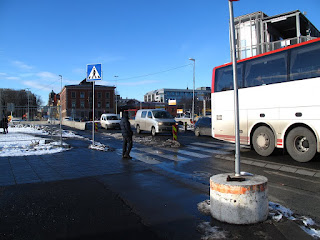 |
| Traffic to be crossed between the Opera plaza and the next pedestrian bridge. |
 |
| View over old Bispelokket site from Opera's pedestrian bridge. |
These aspects of planning and engineering the movement of traffic and humans in machines brings the 1920s German movie Metropolis to mind. There is something particular dystopian about development, especially while it is underway. It is difficult to look at this site today and imagine that in the future it is to be a progressive pedestrian friendly neighborhood that will magically connect the new buildings along the fjord to the existing urban fabric behind the train tracks.
 |
| The plaza in front of the Opera currently stands as a pedestrian friendly island amidst chaos. |
More photos from this site
here.


